Torrential Tannoys – can’t we just have a quiet life?

They say life imitates art, and one area I think this is true is in the growing number of speakers blasting out banal “information” tannoys. If you think of any fiction set in the future with some controlling regime (1984, Brave New World, Blakes 7), there are droning announcements blighting the lives of the citizens as they try to go about their daily business.

Anyone who uses public transport in the UK should be able to relate to this – the never-ending torrent of automated announcements that seem to bury useful information (like which station is next) in a stream of verbose drivel (to mind the gap, take our stuff with us, and remember to breathe).

Is “tannoy” really a portmanteau of “to annoy”?

Continue reading “Torrential Tannoys – can’t we just have a quiet life?”

Happy Hallmark Day

For the avoidance of doubt, I am not single, but still call today “Hallmark day” and despair of the basic concept of vomit-inducing cards, overpriced rose bouquets, and lamb cutlets and other foodstuffs arranged in a schmaltzy heart shape.

Morrisons seem to have taken vomit-inducing food to new depths with a “cupid seasoning” that they are slathering on their steaks today. What sort of marketing desperado signed that load of arse off? (Oh, one earning more money than me, probably. Bugger.)

More to the point, what’s in it? My money is on an anti-emetic.

Quids in for the Bristol Pound?

Interesting BBC News article on the Bristol Pound today.

The Bristol Pound is a localised currency intended to stop the net outflow of cash from Bristol – the idea being that if you paid for a product or service with a Bristol Pound as opposed to a normal Pound Sterling, the trader is required to spend that money as a Bristol Pound themselves – either to pay a local employee, or a local supplier, you get the general idea.

The thinking is that in a recession and in the face of rising globalisation, when a normal Pound is spent in Bristol, a large percentage of it (or even worse, all of it) is exported from Bristol, going into the pockets of people outside of the region. By keeping the money local, it’s an attempt to create a virtuous effect of doing business in the local area, benefitting local businesses and people.

I make no secret I’m a big fan of local reinvestment – I’ve touched on this when writing about localised fast broadband projects such as co-operative ones like B4RN (which might actually achieve this) and large gold-plated schemes like DigitalRegion (which isn’t doing too well at the moment, as a locally-based South Yorkshire DR reseller – Ripwire – has gone bump over the weekend).

Early days for the Bristol Pound yet – they are still inviting suggestions for who should be on their money – obviously the legendary engineer Brunel, who had such an influence on the city, should feature, but what about one of Bristol’s famous fictional sons, like Casualty’s Charlie Fairhead? Or is the irony of the BBC moving the Casualty production from Bristol to Cardiff a bit too much?

WCML Blocked at Bletchley 3/2/2012: How do I get to…

I see that the @NetworkRail, @LondonMidland and @VirginTrains twitter folks are having a tough day today.This is the train we need to rerail at #Bletchley, with all w... on Twitpic

To use railway speak the “job is stopped” (i.e. no trains can run) through the Bletchley area because of this locomotive coming off the rails in the middle of the night last night. Apparently, the driver had to be taken to hospital.

This has had the effect of meaning no services out of London Euston getting further North than Tring, and services heading from the North to Euston getting beyond Milton Keynes.

If you can avoid travelling today, it’s probably a good idea to put off making your trip. It’s going to take a long time to get the line re-opened. You can see that it’s derailed across two tracks, plus the overhead wires which supply electricity to the trains have reportedly been damaged too.

Services are going to be disrupted all day, and most likely into the weekend as well.

There are a lot of folk asking on social media how they can work around this if they need to make the journey. There’s lots of redundancy in the rail network, but the alternatives aren’t always the most obvious.

Getting the Virgin train in to Milton Keynes if you’re heading for London is probably the worst option, as you’re then looking at road transport from Milton Keynes to somewhere like Luton or Aylesbury to get around the disruption.

A number of train operators will be accepting tickets on alternative routes, including those that would normally only be valid on a Virgin train. Please look at the National Rail page to check for these. Virgin have also released some very clear maps of alternatives.

Here’s a basic rundown of my recommendations for alternatives:

London – Scotland: East Coast from/to London Kings Cross, changing at Edinburgh, is likely your best bet.

London – Carlisle: Probably best on Virgin to Birmingham New Street, and then proceed as for Birmingham, on Chiltern. Going across to Newcastle or over the S&C to Leeds is likely to be slow, but is also an alternative, and one of Virgin’s own recommendations.

London – Preston: Again possibly stick with Virgin to Birmingham, and change for Chiltern to Marylebone, as getting across to Leeds from Preston (via Halifax) while one of Virgin’s recommendations, may be slow.

London – Birmingham: Chiltern Trains – Snow Hill or Moor Street to/from Marylebone, direct train, at least 2 trains per hour, approx 1h45 journey time. Or, First Great Western Paddington-Reading, changing for Cross Country Reading-Birmingham.

London – Coventry: First Great Western Paddington-Reading, and change for Cross Country for Reading-Coventry, or Chiltern to/from Marylebone, change at Leamington Spa.

London – Nuneaton: East Midlands Trains to/from Leicester, changing for connections to Nuneaton. This may also work for Coventry.

London – Stoke-on-Trent/Crewe: East Midlands Trains to/from Derby, changing there for Stoke-on-Trent/Crewe, or Chiltern Marylebone to Leamington Spa, and Cross Country from Leamington Spa to Stoke.

London – Manchester: East Midlands Trains to/from Sheffield, or East Coast to/from Leeds, changing there for Manchester. This is probably a good alternative for Liverpool too, as there are direct trains to Liverpool from Sheffield and Leeds.

London – Liverpool: As for Manchester, or route via Birmingham and Chiltern to/from London.

If you’re travelling Virgin north of Milton Keynes (e.g Birmingham-Scotland or Preston-Scotland), the trains are running, but are subject to delay, short notice cancellation, and may make additional stops. Birmingham-Euston and Manchester-Euston services seem to be down to 2 trains per hour and terminate at Milton Keynes in any case.

London Midland Euston-Milton Keynes-Northampton line north of Tring, my advice is to put off your trip. It’s going to be a slow experience and likely involve road transport/buses.

This advice is being provided with no warranty that your specific ticket will be valid via the alternative route. Just trying some ideas to bail you out of the crap if you still feel the need to travel today. Please ask railway staff on the train(s) on which you intend to travel. I am not an employee of a National Rail operating company or Network Rail.

Remember the alternative trains will be busy and the staff will likely feel more than a touch mithered. Please be nice to your fellow humans today. Dunkirk spirit and all that.

Good luck!

Update: As of about 1600 today, they have got one line in each direction re-opened. This is normally a four track railway, there are two sets of lines in each direction – one carrying faster Virgin expresses, the other carrying the London Midland commuter trains, local stopping trains, and slower freight trains. It’s fair to say that there will still be some disruption over the weekend, simply because the timetabled service can’t really fit over the remaining two tracks and keep to time. Keep your eyes on the information that’s available.
Voicemail is a write-only medium

I didn’t bother activating voicemail when I changed my phone.

When I did have voicemail, because it came activated and there was seemingly no way of switching it off, I never used to listen to it. I just occasionally went in and deleted all the messages without listening to them.

I had grown tired of the sorts of messages you normally find your voicemail:

  • A few seconds of silence, followed by the phone being put down.
  • Long, waffly, monologues of messages, where the caller actually tries to have the conversation they want to have with you, without you being present.
  • Messages that are, plain and simple, not for you, but the caller leaves a message anyway, just in case.
  • Ear-splitting background or wind noise such that you can’t hear who’s calling, what the message is about, or what number to call them back on.
  • People nagging you for something you have no intention of doing any time this decade.
  • Salesmen trying to sell you something.
  • Drunken pocket dials, where you get about 3 minutes of the sound of a bar or club in the background.

That’s why I conclude that voicemail is a write-only medium.

Even if you’re a conscientious type who picks up their voicemail and returns the calls, you’re likely to end up wasting time playing voicemail tag.

So when I got the opportunity to not switch my voicemail on, the decision was easy.

I figure that people who need to get hold of me will:

  • Call back sometime  and actually have the conversation they meant to have when I’m actually listening and they have my attention.
  • Send me an email rather than the waffly message.
  • Send me a SMS or WhatsApp if it’s just a quick “attention grab” that they need.
  • Have left a caller ID I recognise so I can just call them back when I see the missed call.

The cynic in me also thinks that voicemail is a clever ploy by the phone companies to part us from yet more of our hard-earned wonga:

  • The caller has to pay for what is effectively an unsuccessful call. Rather than the phone ringing out because it’s not been picked up, it’s automatically picked up after a few rings, and the clock starts for the caller.
    • This is especially bad when calling ladies who can lose their phone in the depths of their bottomless handbag. Never in a month of Sundays are they are going to be able to fish it out and answer it before it goes to voicemail. I know this from experience.
  • Should you be foolish enough to actually go and collect your voicemail messages, you’re generally charged for the privilege of doing it.

So, there you have it. Why voicemail is a write-only medium, and doesn’t really serve a purpose anymore.

When is it (not) a good time to do maintenance?

With the global nature of the Internet and globalisation of businesses, there’s never really a good time to do maintenance. When it’s 1am in London, it’s 5pm in Silicon Valley and people are trying to wrap up their work day, and it’s first thing in the morning in Hong Kong, neither are going to be happy if they have a maintenance outage to deal with at such important times of the day.

So, you choose your disruptive maintenance windows carefully, to try and cause the smallest impact that you can.

However, if you know the users of the system are local, it’s much easier to choose your maintenance windows: usually when there are the least users on the system.

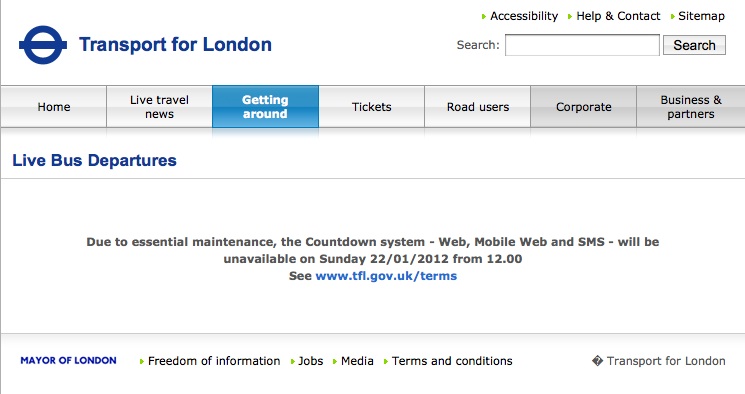
Try telling that to Transport for London.

This is the front end to TfL’s “Countdown” system. It tells you which buses are due at a given bus stop and an approximate time that they arrive. The countdown database is updated using location equipment on the buses, and drives LED displays at bus stops, and is accessible over the Internet, including a user interface designed for mobiles, and via SMS short code.

It’s especially useful when services on a route are infrequent, such as on a Sunday, where you may be looking at waiting up to 20 minutes for a bus if you managed to just miss the previous one. So, look back at the screen grab above, note the start time for the maintenance window.

Why do TfL think it’s a great idea to take the system down right at the time on a Sunday that people are heading out to visit family, maybe go out for Sunday lunch, or head to sporting events?

Wouldn’t a better time be the middle of the night on a Monday, when things are much quieter, with fewer users?

Paying techs extra to do system maintenance on a Sunday can’t be cheap either?

End of the line for buffers?

This could get confusing…The End of the Line by Alan Walker, licenced for reuse under the Creative Commons License

buffer (noun)

1. something or someone that helps protect from harm,

2. the protective metal parts at the front and back of a train or at the end of a track, that reduce damage if the train hits something,

3. a chemical that keeps a liquid from becoming more or less acidic

…or in this case, none of the above, because I’m referring to network buffers.

For a long time, larger and larger network buffers have been creeping into network equipment, with many equipment vendors telling us big buffers are necessary (and charging us handsomely for them), and various queue management strategies being developed over the years.

Now, with storage networks and clustering moving from specialised platforms such as fibre channel and infiniband to using ethernet and IP, and the transition to distributed clustering (aka “The cloud”), this wisdom is being challenged, not just by researchers, but operators and even equipment manufacturers.

The fact is, in lots of cases, it can often be better to let the higher level protocols in the end stations deal with network congestion rather than introduce variable congestion due to deep buffering and badly configured queueing in the network which attempts to mask the problem and confuses the congestion control behaviours built into the protocols.

So, it was interesting to find two articles in the same day with this as one of the themes.

Firstly, I was at the UKNOF meeting in London, where one of the talks was from a research working on the BufferBloat project, which is approaching the problem from the CPE end – looking at the affordable mass-market home router, or more specifically the software which runs on them and the buffer management therein.

Second thing I came across was a great blog post from technology blogger Greg Ferro’s Ethereal Mind – on his visit to innovative UK ethernet fabric switch startup Gnodal – who are doing some seriously cool stuff which removes buffer bloat from the network (as well as some other original ethernet fabric tech), which is really important for the data centre networking market with it’s latency and jitter sensitivity, which Gnodal are aiming at.

(Yes, I’m as excited as Greg about what the Gnodal guys are up to, as it’s really breaking the mould, and being developed in the UK, of course I’m likely to be a bit biased!)

Is the writing on the wall for super-deep buffers?

Regional Broadband – The Hidden Danger of Uber-projects

It was revealed this week that Digital Region, the centrally funded (to the tune of £90m – mostly public money) superfast broadband initiative in South Yorkshire is facing tough times, in particular a £9.2m loss on a revenue of only £167k (which only just pays the last CEO’s £100k salary – they are currently seeking a new CEO, one assumes to manage a turnaround).

The Yorkshire Post article goes on to explain another £4m of public funds have been ringfenced as a “security”, and that the four participating councils, already under budget pressure from Central Government austerity, may need to as much as £500k per year to secure the operations of Digital Region if the loan can’t be repaid. Is that throwing good money after bad, or is the situation redeemable?

This highlights my belief that these large centrally funded uber-projects contain a more significant risk of failure, and not of delivering the right product. The larger organisations that are able to bid and win such projects can come with higher overheads compared to the smaller community projects such as those serving areas with poor existing broadband service, who have a relatively captive and supportive market, and benefit from a tighter focus – for instance Rutland Telecom’s pioneering FTTC with unbundled sub-loop in Lyddington, which is using the same basic FTTC tech as DR is using, but on a smaller scale and in relative isolation.

The larger scale of the Digital Region deployment obviously needed a much bigger income to support the aggressive build and provisioning costs, along with what looks like a complex structure, and now that revenue hasn’t been realised. As can be seen on the DR website, and highlighted on the ThinkBroadband article, very few ISPs use the DR infrastructure to deliver service and is maybe one of the reasons they aren’t making their targets.

You have to ask yourself why this is? Continue reading “Regional Broadband – The Hidden Danger of Uber-projects”

What is it with the Virgin Brand?

Or “Why it’s easy to pick fault with Virgin Group companies“.

You may have noticed that I’ve recently been airing my opinion – or is it pent-up frustration – on the service that Virgin Trains provides on the UK’s West Coast Mainline out of Euston station in London. I long ago gave up trying to interact with their customer relations department about their failure to deliver either a promised element of their product, or sometimes what should be just their basic service – a comfortable journey from A to B.

It got me thinking about the wider point of why people seem easily dissatisfied with a service, and specifically Virgin Group as a whole, trains, planes, phones, tv, internet access, etc. A couple of quick searches, especially on social media, and it’s easy to find people going full tilt hating on Virgin Trains, dishing out brickbats to Virgin Media about busted broadband, or flying off the handle about the run-down (thankfully soon to be updated) Gatwick fleet on Virgin Atlantic.

The crux I’ve arrived at is that the Virgin brand tends to overpromise through it’s marketing and brand image and therefore sets itself up to underdeliver and disappoint.

Let’s look at the key connotations of the Virgin brand: Continue reading “What is it with the Virgin Brand?”

Now for the real “Up In The Air”

If you happened to be bored on a plane sometime in 2010, there’s a high likelihood you’ll have seen the film Up In The Air, and some of you may even relate to it. I remember that United Airlines even had the film doctored to remove much of the obvious product placement for competitor American Airlines from the film!

Air New Zealand 747-400, ZK-SUI by robertjamesstarling, on Flickr
Now, there's a nice plane. Still prefer it to the 777.

At the time, I was doing between 75k and 100k miles in flight each year, and while I wasn’t living the somewhat empty, itinerant existance of George Clooney’s character, I was almost certainly doing more travelling than most so-called “Traveller families” were travelling in the UK.

It meant that I could certainly relate to the film, the lead character’s pursuit of miles and elite status, and the benefits of choosing the correct airport security lane. I expect a lot of people reading this post (“Hi, Internet meeting circuit!”) can also relate to this.

I still never got down to living entirely out of a single roll-aboard case for more than a few days at a time though.

An independent film maker, Gabriel Leigh, has decided to make a feature-length documentary about the real frequent flyers, the people who really are “Up In The Air”, all the time, and often for no apparent reason. The film maker is appealing for backing on Kickstarter to raise the money to make the project.

Of course, the real irony would be if he can manage to fly to all the places he needs to when making the film using redeemed miles, rather than paying for a ticket!

Here’s a 20 minute taster of when he initially explored the phenomenon of the FlyerTalker and mileage runner.

One thing which really struck me about this short video was the chap in Tokyo, when he compared the airport to a city and a city to the airport. Everyone just going about their business, speaking their own language, doing their own stuff, in their own world, rarely interacting?

While it’s a true comparison for the mega-airports like Schiphol, DFW, Frankfurt and Heathrow, do we want our cities, our homes, our environments in which we live every day to become as impersonal as an airport? I don’t doubt for a moment that it is happening, but can’t help feeling I think that would be a sad state of affairs in the evolution of the city in the long term.