UK 4G LTE Launch and the scramble for spectrum

So, the next path on the road to fast mobile data, 4G LTE finally launches in the UK, after much barracking from competitors, on the “EE” network (the combined Orange and T-Mobile brand).

It’s only available in a handful of markets at the moment, and the BBC’s tech correspondent, Rory Cellan-Jones, did many articles for TV and Radio yesterday, while conducting countless speedtests, which he has extensively blogged about.

Some of the comments have been that it’s no better in terms of speed than a good 3G service in some circumstances, while others complain about the monthly cost of the contracts.

Get locked-in to 4G(EE)?

The initial cost for the early adopters was always going to attract a premium, and those who want it will be prepared to pay for it. It’s also worth noting that there are no “all you can eat” data plans offered on EE’s 4G service. Everything comes with an allowance, and anything above that has to be bought as “extra”.

The most concerning thing as far as the commercial package goes are the minimum contract terms.

12 months appears to be the absolute minimum (SIM only), while 18 months seems to be the offering if you need a device (be it a phone, dongle or MiFi), and 24 month contracts are also being offered.

Pay As You Go is not being offered on EE’s 4G service (as yet), probably because they’ve no incentive to, because there’s no competition.

Are EE trying to make the most of the headstart they have over competitors 3, O2 and Voda and capture those early adopters?

Penetrating matters?

Rory Cellan-Jones referred in his blog about problems with reduced performance when in buildings.

A number of factors affect the propagation of radio waves and how well they penetrate buildings and other obstacles, such as the nature of the building’s construction (for instance a building which exhibits the properties of a Faraday Cage would block radio signals, or attenuate them to the point of being useless), but also the frequency of the radio signal.

Longer wavelengths (lower frequencies) can travel further and are less impacted by having to pass through walls. I’m sure there’s an xkcd on this somewhere, but the best I can find is this….

Electromagnetic Spectrum according to xkcd

The reason EE were able to get a steal on the other mobile phone companies was because OFCOM (the UK regulator, who handle radio spectrum licensing for the Nation) allowed EE to “refarm” (repurpose) some of their existing allocated frequency, previously used for 2G (GSM), and convert it to support 4G. The 2G spectrum available to EE was in the 1800 Mhz range, as that was the 2G spectrum allocated to EE’s constituent companies, Orange and T-Mobile.

Now, 1800 does penetrate buildings, but not as well as the 900 Mhz which are the 2G spectrum allocated to Voda and O2.

Voda are apparently applying to OFCOM for authority to refarm their 900 Mhz spectrum for 4G LTE. Now, this would give a 4G service which had good propagation properties (i.e. travel further from the mast) and better building penetration. Glossing over (non-)availability of devices which talk LTE in the 900 Mhz spectrum, could actually be good for extra-urban/semi-rural areas which are broadband not-spots?

Well, yes, but it might cause problems in dense urban areas where the device density is so high it’s necessary to have a large number of small cells, in order to limit the number of devices associated with a single cell to a manageable amount – each cell can only deal with a finite number of client devices. This is already the case in places suce as city centres, music venues and the like.

Ideally, a single network would have a situation whereby you have a high density of smaller cells (micro- and femto-cells) running on the higher frequency range to intentially limit  (and therefore number of connected devices) it’s reach in very dense urban areas such as city centres, and a lower density of large cells (known as macro-cells) running on lower frequencies to cover less built-up areas and possibly better manage building penetration.

But, that doesn’t fit with our current model of how spectrum is licensed in the UK (and much of the rest of the world).

Could the system of spectrum allocation and use be changed?

One option could be for the mobile operators to all get together and agree to co-operate, effectively exchanging bits of spectrum so that they have the most appropriate bit of spectrum allocated to each base station. But this would involve fierce competitors to get to together and agree, so there would have to be something in it for them, the best incentive being cost savings. This is happening to a limited extent now.

The more drastic approach could be for OFCOM to decouple the operation of base stations (aka cell towers) from the provision of service – effectively moving the radio part of the service to a wholesale model. Right now, providing the consumer service is tightly coupled to building and operating the radio infrastructure, the notable exception being the MVNOs such as Virgin (among others), who don’t own any radio infrastructure, but sell a service provided over one of the main four.

It wouldn’t affect who the man in the street buys his phone service from – it could even increase consumer choice by allowing further new entrants into the market, beyond the MVNO model – but it could result in better use of spectrum which is, after all, a finite resource.

Either model could ensure that regardless of who is providing the consumer with service, the most appropriate bit of radio spectrum is used to service them, depending on where they are and which base stations their device can associate with.

First Impressions from “new” Lufthansa “Pier A” at Frankfurt

Connecting through Frankfurt, Lufthansa’s major hub, can sometimes be a fraught experience. Given that the Germans generally have a reputation for efficiency and good design, this may come as a surprise to the unseasoned traveller.

It’s something of a lottery. If you’re connecting between two flights arriving on the same gate area, then it’s easy. If not, then it’s game over. Don’t pack your running shoes – keep them handy in your hand baggage. Continue reading “First Impressions from “new” Lufthansa “Pier A” at Frankfurt”

West Coast Continuation…

…but more wastage could lie ahead.

So, some common sense at the Department for Transport has prevailed, they have extended Virgin Trains’ contract to run the West Coast Main Line trains, following the failure of the recent franchise bid.

As the CEO of rail watchdog Passenger Focus points out, this is generally good for the confidence of the travelling public, who were still convinced that they couldn’t book tickets for journeys post-Virgin in confidence.

But, they’ve only extended it for another 9-12 months. That isn’t long enough for a new specification and full franchise bid to be run.

So, why the short-term extension? Mainly because of EU Competition Law. Apparently, other operators need to be given a fair crack. This means a “short-term” WCML franchise will likely exist, which will run for around 2 to 3 years, while a new competition for the long term franchise is held.

There are legitimate concerns that the short term franchise will be financially unattractive, which implies it will require some sort of subsidy sweetener, some propping up by the taxpayer. It’s also not good for strategic development, as it favours short-term decision making, rather than a long-term vision. There’s also concerns such as uncertain futures for the employees.

How is this ridiculous short-term franchise beneficial for the passenger, the rail industry, and the taxpayer? We may as well go back to steam power and put shovelfuls of £50 notes in the fire. Thanks a lot, Brussels.

Is the Internet facing a “perfect storm”?

The Internet has become a massive part of our everyday lives. If you walk down a British high street, you can’t fail to notice people staring into their phones rather than looking where they are going! I did see a comment on TV this week that you have a 1-in-10 chance of tripping and falling over when walking along looking at your phone and messaging…

There are massive pushes for faster access in countries which already have widespread Internet adoption, both over fixed infrastructure (such as FTTC and FTTH) and wireless (LTE, aka 4G), which at times isn’t without controversy. In the UK, the incumbent, BT, is commonly (and sometimes unfairly) criticised for trying to sweat more and more out of it’s copper last mile infrastructure (the wires that go into people’s homes), while not doing enough to “future-proof” and enable remote areas by investing in fibre. There’s also been problems over the UK regulator’s decision to allow one mobile phone network get a head-start on it’s competitors in offering LTE/4G service ahead of them, using existing allocated radio frequencies (a process known as “spectrum refarming”).

Why do people care? Because the Internet helps foster growth and can reduce the costs of doing business, and it’s why the developing countries are working desperately hard to drive internet adoption, along the way having to manage the threats of “interfering” actors who either don’t fully understand or fear change.

However, a bigger threat could be facing the Internet, and it’s coming from multiple angles, technical and non-technical. A perfect storm?

  • IPv4 Resource Exhaustion
    • The existing addressing (numbering) scheme used by the Internet is running out
    • A secondary market for “spare” IPv4 resources is developing, IPv4 addresses will have a monetary value, driven by lack of IPv6 deployment
  • Slow IPv6 Adoption
  • Increasing Regulatory attention
    • On a national level, such as the French Regulator, ARCEP, wishing to collect details on all interconnects in France or involving French entities
    • On a regional level, such as ETNO pushing for regulation of interconnect through use of QoS – nicely de-constructed by my learned colleague Geoff Huston – possibly an attempt to retroactively fix a broken business model?
    • On a Global level through the ITU, who, having disregarded the Internet as “something for academics” and not relevant to public communications back in 1988, now want to update the International Telecommunication Regulations to extend these to who “controls the Internet” and how.

All of these things threaten some of the basic foundations of the Internet we have today:

  • The Internet is “open” – anyone can connect, it’s agnostic to the data which is run over it, and this allows people to innovate
  • The Internet is “transparent” – managed using a bottom-up process of policy making and protocol development which is open to all
  • The Internet is “cheap” – relatively speaking, Internet service is inexpensive

These challenges facing the Internet combine to break all of the above.

Close the system off, drive costs up, and make development and co-ordination an invite-only closed shop in which it’s expensive to participate.

Time and effort, and investing a little money (in deploying IPv6, in some regulatory efforts, and in checking your business model is still valid), are the main things which will head off this approaching storm.

Adopting IPv6 should just be a (stay in) business decision. It’s something operational and technical that a business is in control of.

But, the regulatory aspect is tougher, unless you are big enough to be able to afford your own lobbyists. Fortunately, if you live in the UK, it’s not reached “write to your MP time”, not just yet. The UK’s position remains one of “light touch” regulation, largely letting the industry self-regulate itself through market forces, and this is being advocated to the ITU. There’s also some very bright, talented and respected people trying to get the message through that it’s economically advantageous not to make the Internet a closed top-down operated system.

Nevertheless, the challenges remain very much real. We live in interesting times.

West Coast Rail Franchise hits the buffer stops

BBC Breakfast journalist Susannah Reid: “Well, this is all very embarrassing for you.”

Transport Secretary, Patrick McLaughlin: “Yes”

Late last night, the UK Government brought a stop to the controversial Inter City West Coast rail franchise, which had been awarded to First Group, displacing the incumbent franchisee Virgin Trains.

Not only was there criticism that the DfT had awarded the franchise to First largely on the basis that it offered the Treasury more money over the life of the franchise, but that the First bid was also allegedly “lower quality”, while Virgin criticised the First bid as”unsustainable”, suggesting that First’s West Coast operations would go the way of East Coast out of Kings Cross – that First would surrender the the franchise, and the Government would be left to use public money to pick up the pieces.

There was also public outcry and grass-roots “underdog support” for Virgin’s operations, including a massive e-petition to Government to urge investigation and reconsideration of the decision.

Due to give evidence this to the judicial review Virgin had requested, the Government have slammed the brakes on hard, while reportedly some DfT staff members involved in the process have been suspended pending an investigation.

But, this all has a cost to the taxpayer.

Firstly, the Government have said they will need to reimburse costs to the franchise applicants – and this probably means the non-shortlisted companies (Abellio and Veolia) as well as First and Virgin. Branson’s blog said that the recent ICWC bid cost Virgin £14m, just to put the franchise bid together.

So, we’re looking at shelling out something in the region of £50m of public money to the companies who applied for the franchise, to defray their expenses in placing bids.

There’s also the question of who operates the West Coast from December. There’s two main options – 1) Allow Virgin to continue, or 2) Have the DfT directly operate the railway, as on the East Coast route from Kings Cross.

Branson had previously offered to continue running the trains while the decision was reviewed.

If this offer still stands, and is non-prejudicial, it would be foolish of the DfT to squander even more public money by not taking it up.

Update 20.00 3/10/12:

The CEO of Passenger Focus has made a very valid point on his blog: Passenger confidence must be maintained. People are creatures of habit and don’t like uncertainty.

Is the new mapping app the “killer app” for iPhone 5?

For those of you brave enough to upgrade your iGadgets to iOS6, you get a sneak preview of one of the “enhancements” Apple will be shipping with the iPhone 5 – their own mapping application.

Basically, it ain’t great. Mispelled placenames…

by Tom Wardill on Twitter
Duncaster?

Oh, and in case anyone at Apple is listening, Motorways are normally coloured BLUE on maps in the UK and Europe.

Significantly less detail…

Educational Wasteland?

But, I’ve seen people who like Apple’s 3D maps (using aerial imagery). A case of eye candy over substance?

Update: Seems the finger-pointing between Tom Tom (who provided backend data for Apple’s maps) and Apple has already begun.

Android is looking really attractive right now.

Chiltern’s offer to Richard Branson…

“…need a lift, Sir Richard?” Photo by @Gracey_Mills

Cheeky marketing by Birmingham to London competitor Chiltern Railways, encouraging passengers to try out their Mainline service.

Those who do try out Chiltern Mainline might be pleasantly surprised to find:

  • Cheaper fares.
  • Journey times that are only slightly longer than on Virgin, and maybe be end-to-end shorter if you’re closer to one of Chiltern’s stations.
  • Seats which line up with the windows.
  • Tables and power sockets.
  • Free wifi.

It’s one of the few places in the UK where you can find some genuine competition on a city centre to city centre rail service.

Chiltern have made massive improvements and real investments, i.e. spent their own cash, not claimed investment of public funds as their own, on the route and have worked hard to build a good relationship and understanding with their travelling public.

The CEO of Passenger Focus recently wrote this blog article on his positive Chiltern Mainline experience, and wondered how they can continue to grow the service. I suggested ia a comment that recommendation, word-of-mouth, is very strong in helping the Chiltern cause, but even tongue-in-cheek marketing like this has it’s place.

There’s one thing about the “wrapper ad” on the Metro which strikes me as bizarre. The words “Book now”.

Continue reading “Chiltern’s offer to Richard Branson…”

Customer Service is Crucial

When I need to get a memory upgrade for one of my own machines or for someone I know, I tend to go straight to Crucial. I usually don’t even bother looking anywhere else anymore. Thats where I went on Monday evening to order an upgrade for one of my machines.

Why? Well, partly because I’m lazy. Partly because I’m a man, and I mostly hate shopping. Even online.

But most of all, there’s a positive reason I’ll go back to Crucial. I’ve never been unhappy with their products or service, I’ve never had to return anything, they are competitively priced, and they always deliver things when they say they will, or do even better!

That memory upgrade I ordered on Monday night? I decided I’d pay the extra couple of quid to get it sent more quickly than their 3-5 day free standard postal delivery. I got an email yesterday, early evening, confirming my memory had been dispatched, and with a tracking number.

It arrived at about 0830 this morning, by Royal Mail Special Delivery, which costs us mere mortals about £6 if we go and send anything SD ourselves from the post office. Fantastic.

I know, I’m waxing lyrical about a company just going about it’s business of delivering the service and product I’ve paid for. But when you hear so often about companies who can’t keep their promises, it’s great when you find one that consistently can.

This Mac is much happier now, and I’m seeing fewer spinny beachballs.

Recent IPv4 Depletion Events

Those of you who follow these things can’t have missed that the RIPE NCC had got down to it’s last /8 of unallocated IPv4 space last week.

They even made a cake to celebrate…

Photo (and cake?) by Rumy Spratley-Kanis

This means the RIPE NCC are down to their last 16 million IPv4 IP addresses, and they can’t get another big block allocated to them, because there aren’t any more to give out.

Continue reading “Recent IPv4 Depletion Events”

When your staff are your best asset…

All stop on the West Coast yesterday, as a mahoosive signal failure at the important Motherwell signalling centre brought everything to a stand between the Scottish Border and Glasgow and Edinburgh. A number of people were stuck on trains in the affected area, which were unable to move for as long as three hours. Other trains were held at the station stop prior to entering the affected area, such as Carlisle.

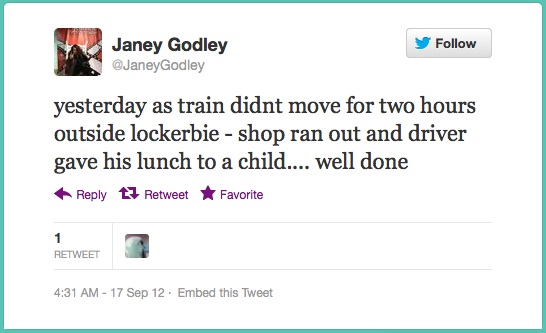
One of the stuck people was comedienne Janey Godley, who appeared to be slowly losing her mind despite travelling in First Class, and tried to open up a 140 character at a time dialogue with the @virgintrains twitter person.

Eventually things got on the move again, and while Janey had to settle for sausages as opposed to “sex and mince”, today she did point out the kindness of the on-train crew toward the passengers during the extended delay…

Nicely done by the Virgin Trains’ On-Train staff, who seemed to put a human face on the extended delay. Good to see that staff morale is still relatively high despite the ongoing wrangling over the franchise. Talking of which…

As Virgin Rail Group has applied for a judicial review of the DfT decision to award the “ICWC” franchise to First Group, this has brought the franchise handover date itself of 9th December into question.

We’ve got the Branson offer to continue to run the franchise on a non-profit basis (donating profits to good causes) while the review proceeds.

However, the other option is that the DfT take control of the franchise until such time as it can be awarded and smooth transfer of responsibility can happen, not dissimilar as they had to do with East Coast.

But, ask yourself, is it a good use of public funds to incorporate a new entity to run ICWC on an interim basis (this includes hiring management, etc.), rather than accept Virgin’s offer to keep things on an even keel until a decision can be made.

As long as the VRG offer can be taken on a non-prejudicial basis, could this be delivering best value for the taxpayer?

In any case, spare a thought for the staff caught up in this…