Torrential Tannoys – can’t we just have a quiet life?

They say life imitates art, and one area I think this is true is in the growing number of speakers blasting out banal “information” tannoys. If you think of any fiction set in the future with some controlling regime (1984, Brave New World, Blakes 7), there are droning announcements blighting the lives of the citizens as they try to go about their daily business.

Anyone who uses public transport in the UK should be able to relate to this – the never-ending torrent of automated announcements that seem to bury useful information (like which station is next) in a stream of verbose drivel (to mind the gap, take our stuff with us, and remember to breathe).

Is “tannoy” really a portmanteau of “to annoy”?

Continue reading “Torrential Tannoys – can’t we just have a quiet life?”

Happy Hallmark Day

For the avoidance of doubt, I am not single, but still call today “Hallmark day” and despair of the basic concept of vomit-inducing cards, overpriced rose bouquets, and lamb cutlets and other foodstuffs arranged in a schmaltzy heart shape.

Morrisons seem to have taken vomit-inducing food to new depths with a “cupid seasoning” that they are slathering on their steaks today. What sort of marketing desperado signed that load of arse off? (Oh, one earning more money than me, probably. Bugger.)

More to the point, what’s in it? My money is on an anti-emetic.

Voicemail is a write-only medium

I didn’t bother activating voicemail when I changed my phone.

When I did have voicemail, because it came activated and there was seemingly no way of switching it off, I never used to listen to it. I just occasionally went in and deleted all the messages without listening to them.

I had grown tired of the sorts of messages you normally find your voicemail:

  • A few seconds of silence, followed by the phone being put down.
  • Long, waffly, monologues of messages, where the caller actually tries to have the conversation they want to have with you, without you being present.
  • Messages that are, plain and simple, not for you, but the caller leaves a message anyway, just in case.
  • Ear-splitting background or wind noise such that you can’t hear who’s calling, what the message is about, or what number to call them back on.
  • People nagging you for something you have no intention of doing any time this decade.
  • Salesmen trying to sell you something.
  • Drunken pocket dials, where you get about 3 minutes of the sound of a bar or club in the background.

That’s why I conclude that voicemail is a write-only medium.

Even if you’re a conscientious type who picks up their voicemail and returns the calls, you’re likely to end up wasting time playing voicemail tag.

So when I got the opportunity to not switch my voicemail on, the decision was easy.

I figure that people who need to get hold of me will:

  • Call back sometime  and actually have the conversation they meant to have when I’m actually listening and they have my attention.
  • Send me an email rather than the waffly message.
  • Send me a SMS or WhatsApp if it’s just a quick “attention grab” that they need.
  • Have left a caller ID I recognise so I can just call them back when I see the missed call.

The cynic in me also thinks that voicemail is a clever ploy by the phone companies to part us from yet more of our hard-earned wonga:

  • The caller has to pay for what is effectively an unsuccessful call. Rather than the phone ringing out because it’s not been picked up, it’s automatically picked up after a few rings, and the clock starts for the caller.
    • This is especially bad when calling ladies who can lose their phone in the depths of their bottomless handbag. Never in a month of Sundays are they are going to be able to fish it out and answer it before it goes to voicemail. I know this from experience.
  • Should you be foolish enough to actually go and collect your voicemail messages, you’re generally charged for the privilege of doing it.

So, there you have it. Why voicemail is a write-only medium, and doesn’t really serve a purpose anymore.

When is it (not) a good time to do maintenance?

With the global nature of the Internet and globalisation of businesses, there’s never really a good time to do maintenance. When it’s 1am in London, it’s 5pm in Silicon Valley and people are trying to wrap up their work day, and it’s first thing in the morning in Hong Kong, neither are going to be happy if they have a maintenance outage to deal with at such important times of the day.

So, you choose your disruptive maintenance windows carefully, to try and cause the smallest impact that you can.

However, if you know the users of the system are local, it’s much easier to choose your maintenance windows: usually when there are the least users on the system.

Try telling that to Transport for London.

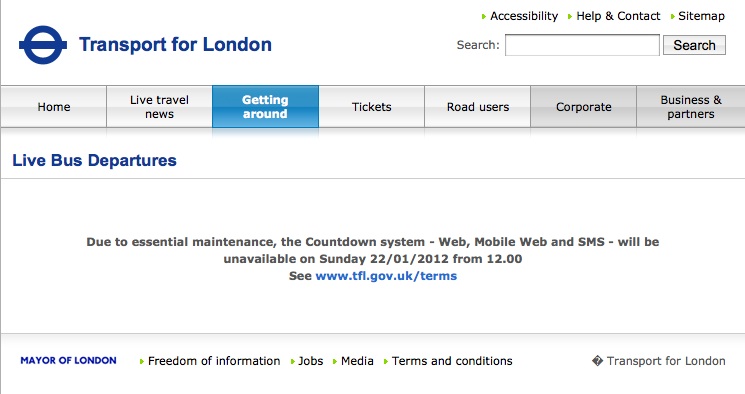
This is the front end to TfL’s “Countdown” system. It tells you which buses are due at a given bus stop and an approximate time that they arrive. The countdown database is updated using location equipment on the buses, and drives LED displays at bus stops, and is accessible over the Internet, including a user interface designed for mobiles, and via SMS short code.

It’s especially useful when services on a route are infrequent, such as on a Sunday, where you may be looking at waiting up to 20 minutes for a bus if you managed to just miss the previous one. So, look back at the screen grab above, note the start time for the maintenance window.

Why do TfL think it’s a great idea to take the system down right at the time on a Sunday that people are heading out to visit family, maybe go out for Sunday lunch, or head to sporting events?

Wouldn’t a better time be the middle of the night on a Monday, when things are much quieter, with fewer users?

Paying techs extra to do system maintenance on a Sunday can’t be cheap either?

I’m sorry. I didn’t quite understand that. Please state “Yes” or “No”

There’s a perfect tv programme, just up my street, airing next week…

Maybe it’s just the grumpy old man in me, but I don’t enjoy dealing with call-centre systems that have complex menu trees, repetitive announcements, auto-attendants, IVRs, and being told that my “business-is-important-thankyouforholding”.

Why can’t a person just pick up the phone and speak to me?

There is a cynical thing going on in some cases – a shady need for the company you’re phoning to keep you on the phone for a while – Call Revenue Sharing. This is where the destination of the phone number recieves a portion of the call termination revenue from the phone company. If the call isn’t long enough, the revenue share is negligible. The cynic in me, saying “yes” or pressing “1” for the umpteenth time, thinking this IVR or menu tree is designed to make the call sufficiently long enough to bring money into the organisation.

I’m therefore looking forward to Channel 4’s Richard Wilson On Hold which is broadcast at 8pm on Monday 16th January. I wonder if they will touch on Revenue Sharing, or just concentrate on the grumpy annoyance factor.

The Asshole Effect

Sort of a follow-up to my post on “How to Reset a Broken Culture?”, I was recently directed to this great blog post on the “Asshole Effect” – which promotes the maxim that, basically, really successful companies don’t employ assholes.

It brought a smile to my face. Particularly the multiplication effect of having hired one idiot, you’ll end up with more, so you want to avoid hiring any in the first place, if at all possible.

So maybe this is the way to fix a broken culture? Systematically purge the organisation of the people who are dragging it down, starting at the top.

I guess the question here is can your already battered brand withstand the short-term unrest in the time it takes to purge the non-desireables from your employ?

It’s an interesting theory. Would love to see it in practice.

15 Years of INEX, me one year on

There were two anniversaries last week. The first was the 15th Birthday of INEX – the Internet Exchange Point in Dublin. To celebrate this, they organised a rather good event at Dublin’s history-steeped Mansion House (the first Dáil sat there in 1919) complete with distinguished speakers such as Dan Kaminsky and Geoff Huston, and a rather good dinner from the adjoining Fire Restaurant.

It was also Arthur’s Day, another excuse to drink copious quantities of the black stuff. Coincidence? You decide…

Dan spoke for over an hour, including Q&A, with no slides, no sheaf of notes, just this interesting stream of consciousness that made you want to sit up and listen.

Some things that Dan said got me thinking, not least the comment that “The world’s social life is being run from Silicon Valley”, and more to the point by a bunch of nerds (e.g. Facebook, G+, etc.), maybe some of the most anthrophobic people you might find! This linked up with some other stuff I’d been reading.

So I thought I’d try and make sense of what was going through my mind. Continue reading “15 Years of INEX, me one year on”

Dell Acquisition Taking Hold at Force 10?

It seems the rDell/Force 10 combined logoecent acquisition of Force 10 by Dell is starting to make itself felt, and not only in a change of the logo on the website.

Eagle-eyed followers of the product information on their website will have noticed the complete disappearance of the product information for the chassis-based Zettascale switch, the Z9512, which was announced back in April. Continue reading “Dell Acquisition Taking Hold at Force 10?”

Music to hide behind the sofa to

The return of the UK’s favourite time-traveller, Doctor Who, to our screens this weekend, is likely to remind people from my generation of their childhood, afternoons spent hiding behind the sofa while the Doctor takes on the Cybermen or the Daleks.

We usually didn’t even have to wait for the inevitable confrontation between our hero and his enemy before hiding behind cushions. Usually, all we needed to hear was this music…


This bit of 1960’s musical electronica, written by composer Ron Grainer, arranged and realised by BBC Radiophonic Workshop genius Delia Derbyshire, is probably responsible for striking fear and trepidation into the hearts of many under 11s over the years. Probably more so than the wobbly sets and dodgy low-budget special effects ever were.

But some may not know that making kids hide behind the sofa seemed to be, maybe unwittingly, a speciality of Grainer and his TV theme work.

The other thing to hide behind the sofa to back in 1979 was another Grainer composition, this…


A series of short stories with twists, Tales of the Unexpected was staple programming in the Sunday ITV schedule in the late 1970s and early 1980s. Hearing this theme music was either a sign that you had probably stayed up too late, your cue to go and have a bath, or go to your room and do something else altogether more happy and childlike.

It seemed to be designed to strike fear into the hearts of innocents, from Grainer’s gently teasing theme tune, to the title sequence with the silhouetted dancing woman, flames, guns, tarot cards and voodoo mask shit, and Roald Dahl’s creepy fireside intro to the story sat in that leather high-backed chair. Even Anglia’s gallant knight on horseback seemed positively sinister, heralding the entry into the bizzare, scary and (frequently) low-budget world of Tales of the Unexpected.

Today it seems almost irrational that these pieces of music should have had such power at the time, but maybe that’s the skill in someone like Ron Grainer, who died 20 years ago this month, to set the tone and create such powerful assciations in our minds.

Even now, both pieces of music make the hairs on the back of my neck stand up and bring back vivid childhood memories, and it’s not just me, right? What TV music were you apprehensive, scared or downright terrified of?

Not-so-instant messaging

I work in the Internet operations industry. Most (maybe all) of the people I know in the industry use some form of instant messaging all the time. A hell of a lot of us still use one of the great ancestors of IM, IRC. We organise, keep in touch, and do business over IM.

We leave our IM client(s) running all the time, so the moment we open our laptop lid, it logs back in to the IM platform(s) of choice and we’re back online straight away, available to our circle of contacts.

Even if we’re nowhere near the computer, we’ll often still be in IM: We might have manually set that we’re “away”, or depend/hope/pray that the “idle” feature of our client will mark us away, when we’re not paying attention. It’s not unusual to return and find a handful of IM messages waiting for us. I then just process them like any other message, be it email, voicemail, or whatever – respond if it’s needed, take in the message if it’s informational, delete it if it’s not relevant.

Now, here’s the cultural difference…

Folks I know who aren’t Internet Ops sort of folk get agitated when they leave me a message over IM and I don’t respond straight away. They think I’m deliberately ignoring them by not answering them instantly. They’ve even got bent out of shape at me because I’ve not answered them straightaway (“Damnit! I thought this thing was supposed to be instant!”). They don’t realise that I’ve walked away from my keyboard.

While I might virtually be there, I’m not really there at all. “Thank you for your note, I’ll get back to you soon.” I guess if it’s really urgent, they could just pick up the phone.

Their culture seems to be to only use their IM client when they want to chat, when they are sat in front of their keyboard. They find the concept of walking away and leaving stuff on alien. I know that my folks think it’s completely bizarre. They also have all the annoying bleeps and buzzes turned on for message alerts, so they are instantly aware of someone wanting their attention, too, and can reply straight away.

If my industry colleagues are anything like me, all those bleeps and bongs are turned off, they certainly are on my systems. I will have no idea I’ve recieved an IM, unless I look, or I happen to be watching when a little popup background alert floats by.

I guess the message here is that while the medium is instant, nothing else about it is…