Apparently, according to @gogo and @AmericanAir this blog is adult themed.

Well. If you ask American Airlines or GoGo Inflight Wifi, this blog is blocked because it contains “adult-and-pornography”…

Apparently, you're looking at pr0n
Apparently, you’re looking at pr0n. Right now.

A reader just contacted me from Flight Level 330 to let me know he couldn’t read my blog. (Well, I suppose people need something to help them sleep…)

Looks like it’s the attack of some overzealous content filters, or maybe GoGo Inflight didn’t agree with my opinions on implementing event and public wifi?

Event (or Public) Wifi. It’s not that difficult.

A not uncommon source of frustration is poor wifi access in public spaces such as hotels, airports, etc., and by extension, poor wifi at events. We’ve all seen the issues – very slow downloads, congestion, dropped connections.

One of the things I do is regularly attend Internet industry events, and by nature of what they are, they are full of geeks, nerds and other types of “heavy user”, and they need their own significant wifi capability to support the event. Yet even those events, which don’t rely on the in-house wifi provision, still run into problems – for instance, the most recent NANOG meeting had some significant wifi issues on the first day, though they did have the challenge of serving over 800 users in a relatively tight space.

I’ve also been involved in setting up connectivity at meetings, so I know from experience that it’s not that difficult to provide good quality wifi. You just need to make a little bit of effort.

This is probably the first of a short series of posts, where I’ll share nuggets of wisdom I’ve picked up along the years. I’m going to assume that if you’re reading this, you know a bit about wifi.

1) Band steering does not work reliably enough

Wi-fi operates on two bands, 5GHz and 2.4GHz. The 2.4GHz spectrum is congested. Most modern clients support both bands. Band steering is an attempt to force clients that can use the 5GHz spectrum off the 2.4GHz spectrum. It works by having a base station “ignore” 2.4GHz association attempts from a client that can associate on 5GHz.

However, experience shows that this is not reliable for all clients, and many clients which could be associated with a 5GHz base station end up associated not only with a 2.4GHz base station, but one which is suboptimal (e.g. further away).

Band steering seems especially problematic when enabled on autonomous base stations. At least on a centrally orchestrated controller-based network, the controller can simultaneously tell all base stations to band steer a particular client.

Which leads me on to…

2) Run separate SSIDs for 5GHz and 2.4GHz bands

If band steering is unreliable, then you need some other way of getting clients on the “right” wifi band. Running separate SSIDs is the best way of doing this.

The majority of modern clients support 5GHz (802.11a). I would therefore recommend that your main/primary SSID is actually 5GHz only. All the clients will ordinarily connect to that.

You can then set up a second SSID which could end in “-2.4” or “-g” or “-legacy” for the non-5GHz clients to connect to. The 2.4GHz clients will only see this SSID and not the 5GHz one. There are significantly fewer 2.4GHz clients around these days.

At the end of the day, both the 5GHz and 2.4GHz wifi SSIDs should then still be bridged to the same backend network so that the network services are the same for the 5GHz and 2.4GHz clients.

3) Turn off 802.11b

Are there any 802.11b only devices still around in regular use?

Disabling 802.11b will restrict your 2.4GHz spectrum to .11g capable devices only, and has the effect of raising the minimum connect speed.

If you know you don’t have to support legacy 802.11b devices, switch off support for it.

4) Restrict the minimum connect speed

The default configuration on some base stations, especially if 802.11b is switched on, is to accept wifi connect speeds as slow as 1Mb/sec.

All you need is one rogue, buggy or distant client to connect at a slow speed and this acts as a “lowest common denominator” to bring your wifi to it’s knees, slowing all clients on that base station to a crawl.

Right. That’s it for today.

Eventually I’ll be showing you how you can run wifi for a 200-300 person meeting out of a suitcase.

Waiting for (BT) Infinity – an update

I mentioned in my last post about my partner’s Mother moving home this week, and how it looks like BT have missed an opportunity to give a seamless transition of her VDSL service.

The new house was only around the corner from the old one, so should be on the same exchange, and maybe even on the same DSLAM and cabinet. It had previously had VDSL service, judging from the master socket faceplate.

20140624_103830

Was the jumpering in the cab over to the DSLAM still set up? Well, we dug out the old BT VDSL modem and HomeHub 3, and set those up.

Guess what…

20140626_144809The VDSL modem successfully trained up. The line is still connected to the VDSL DSLAM.

However, it’s failing authentication – a steady red “b“. Therefore it looks like the old gear won’t work on the new line.

But then the new HomeHub 5 they’ve needlessly shipped out won’t work either: we set that up too, and get an orange “b” symbol.

Evidently, something isn’t provisioned somewhere on the backend. Maybe the account credentials have been changed, or the port on the DSLAM isn’t provisioned correctly yet.

Does this look like a missed opportunity to provide a seamless transition, without the need for an engineer visit, or what?


When parents-in-law move homes – a tale of being “default” tech support

Sheesh BT.

The MiL has moved. Around the corner from her old house. She had BT Infinity (BT’s Retail FTTC product) at the old house. She ordered the service to be moved. The voice service was activated on the day she moved, but not the Internet access.

The new house has previously had FTTC with the last occupant, it has the FTTC faceplate. One can only assume that the “double jumpering” to the FTTC MSAN is still in place too.

I wouldn’t mind betting that it’s even coming off the same bloody street cab/MSAN.

Can we just take the old Homehub 3 and VDSL modem over and plug those in? Oh no.

BT have sent a new Homehub 5 and scheduled an engineer visit for Friday, 5 days after she’s moved in.

It just feels a bit wrong, and maybe even on the crazy side. In theory this could have been done as a simultaneous provide – i.e. both the voice and the internet service brought up at the same time, and in this case potentially without an engineer visit!

Who knows why it’s not happened. Certainly the MiL wouldn’t have known to ask for a “sim-provide”, but should she have to?

Ken Morrison – A simple business philosophy

Recently the UK supermarket chain Morrisons has been in the news, regarding the state of the business, potential job cuts, and a lambasting for the Board at the recent company AGM from former chairman and straight-talking Yorkshireman Sir Ken Morrison, son of the company’s founder.

While CEO of the company, he was known for reportedly “skip diving” on visits to his Morrison’s stores – sifting through the bins to see what was being thrown out and wasted. Sir Ken has a simple philosophy to the supermarket business – “shop in your own shops, get to know your customers and don’t make presidential visits“.

It seemed to work well for him, for Morrisons was profitable for good number of years, until, in 2004, Morrisons acquired Safeway UK (by then already independent from it’s US namesake), a company who I used to work for as a teenager.

One of the things which used to irk me about the way that Safeway was managed was the way that the senior management conducted visits of the stores. When it was known that the regional manager was visiting, significant amounts of overtime became available. The store would be scrubbed top to bottom, the normally messy behind the scenes stockrooms would be tidied up, the shelves would be neatly filled and faced up, and almost every checkout would be open.

This resulted in the management not seeing the real experience, but some sort of show, or “shop in a bottle”.

The very “presidential visits” that Ken Morrison speaks of.

To borrow Sir Ken’s turn of phrase, they left with a “bullshit” experience of what shopping in one of their stores was like. They thought it was okay, and didn’t suck.

Even on short notice “unannounced” visits, somehow the store was tipped off, either by other local managers or by more junior flunkies of the regional managers, fearing for their own jobs if a shop was seen in disarray. Of course, overtime was rapidly offered, and 90% of the time you would take it because you wanted the money.

It seems that Morrisons’ management have picked up this behaviour along with a number of other bad habits from the Safeway acquisition.

One of my own pet hates is the way they build-out the aisle ends with free-standing stacks of items on promotion. This narrows the aisle width, reducing circulation area, and making it harder to manoeuvre your trolley, for fear of knocking over this teetering pile of products.

Obviously the idea is you take something from this wobbly pile to reduce it in size!

Tesco still aren’t much better. It’s a confusing environment of bright yellow price tags, contradictory “special non-offers”, and shouty shelf-edge “barkers”. It’s just a meh experience, and that’s after you’ve battled your way in past all the TVs, clothes and other crap they sell in the big stores.

Also, you’ve got to look if the business model is wrong? Are Morrisons working to a growth-centric business model? In a saturated market such as grocery shopping, the growth most likely has to come from stealing market share from a competitor. This likely comes with a higher cost of sale, as you’ve got to do something to make that fickle customer choose you today. Should Morrisons instead be looking after it’s own customers and working to a retention-based business model?

Rather than providing an unpleasant and stressful experience, do something to make your customers want to come back. You can’t compete on price alone or Aldi and Lidl will take your business away, and the niche high-ends are dominated by the likes of Waitrose and M&S.

I can’t help feeling that devouring Safeway was a meal that still gives Morrisons indigestion to this day, and they would maybe do better following Ken Morrison’s three simple tenets by which he ran the business for many years: good staff, good suppliers, loyal customers.

Read the BBC article and watch the interview with Ken Morrison

What’s next for Open-IX?

I’ve recently returned from the NANOG 61 meeting in Seattle (well, Bellevue, just across the lake), a fantastic meeting with well over 800 attendees. It was good to meet some new folk as well as catch up with some industry contacts and old friends.

One of the topics which came up for discussion was the activities of the Open-IX association. This is a group which exists to promote fairness and open competition between Internet Exchange and Co-location operators in the US, and thus improve the competitiveness of the market for the users of those services, such as ISPs and content providers.

It was originally set-up to address what was something of a market failure and a desire by a number of US network operators to encourage organisations that run Exchange facilities (such as Equinix) to have more transparent dealings with their customer base, such as fair pricing and basic expectations of service level. This is something that is more common in Europe, where a large majority of Internet Exchanges are run as non-profits, owned and steered by their participant communities.

To do this, the Open-IX Association don’t actually plan to own or operate exchanges, but instead act as a certification body, developing a set of basic standards for exchange companies to work to. It’s somewhat succeeded in it’s initial goals of correcting the market failure. New IXP entrants in the shape of the three large European IXPs have entered the North American market, and co-location operators who were previously less active in the interconnection market have become more engaged.

So, one of the questions asked is what next for Open-IX?

(Indeed, my former boss, LINX CEO John Souter even ventured to suggest it’s “served it’s purpose” and could be wound up.)

There has been questions from some smaller IXPs, they can’t meet all the criteria laid down in the OIX-1 standard (and possibly don’t wish to or have means of doing so). Does this some how make them a “less worthy” second-class IXP, despite the fact that they serve their own communities perfectly well?

In particular, both the Seattle Internet Exchange and Toronto Internet Exchange currently can’t comply with OIX-1, but at the same time it’s not important for them to do so. The difference being these are member-driven exchanges, more along the lines of the European model. Their members don’t require them to provide the services which would allow the organisations to confirm to OIX-1.

I don’t think anyone would venture to suggest that the SIX or TorIX are in some way “second class” though, right? They are both well run, have plenty of participants on the exchange fabric, and respected in the IX community.

This is a key difference between these exchanges and commercial operations such as Equinix: The member-driven IXPs such as SIX and TorIX don’t need an Open-IX to set standards for them. Those local communities set their own standards, and it’s worked for them so far.

And maybe that’s where the opportunity lies for Open-IX: To act like this “conscience” for the more commercial operators, in the same way as the members steer the non-profits?

UKNOF 29 Tech Recce – Belfast

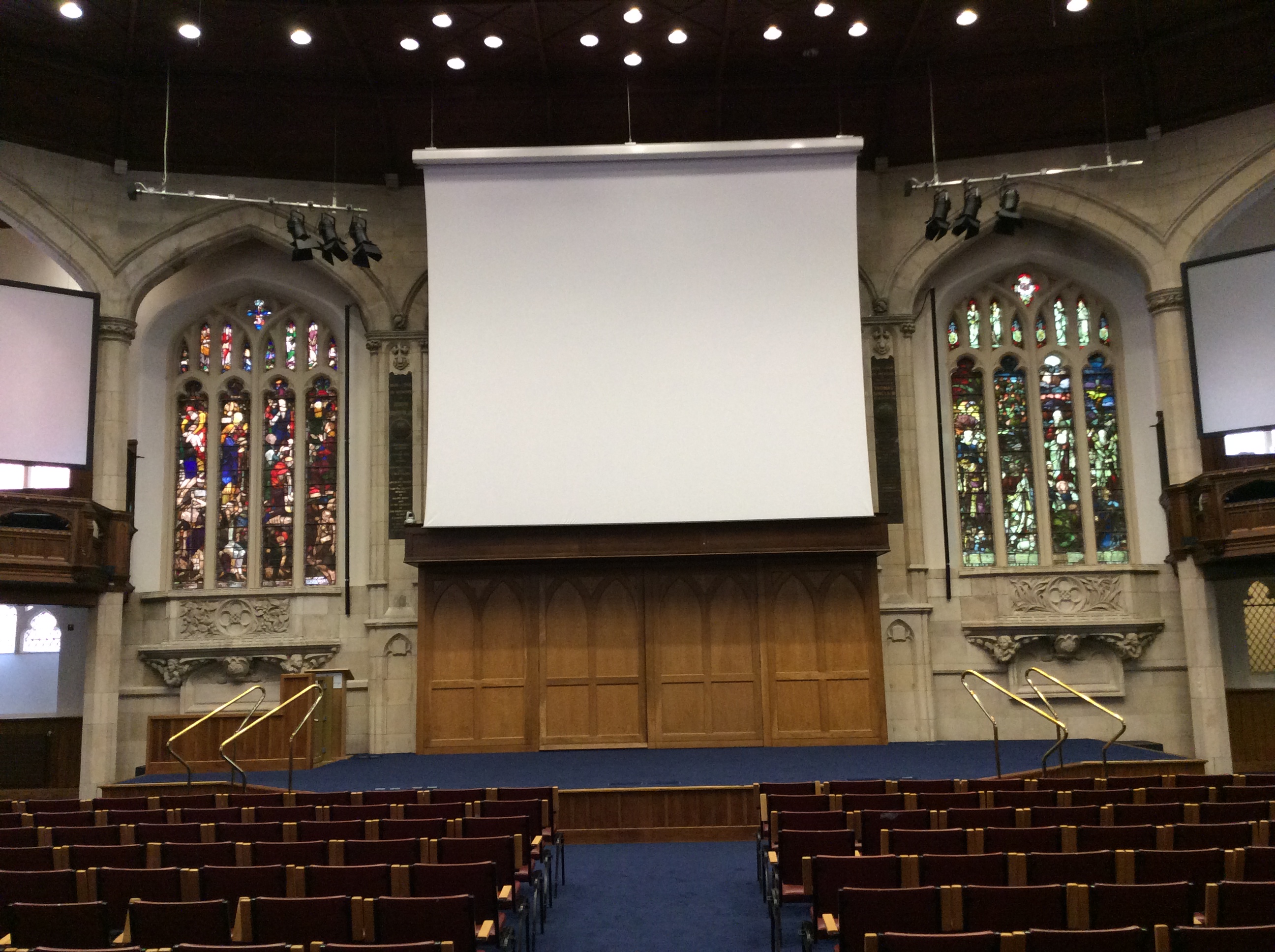
Assembly Buildings Belfast - Main Hall

The venue for UKNOF 29 and ISOC’s ION Belfast meeting to be held in September this year is currently looking like another great place for UKNOF to meet – it’s the Assembly Buildings, right in the middle of the city, easy to get to, and a good choice of hotels (from budget options such as Travelodge through to mid-range Jury’s Inn, and the higher end Europa and boutique Fitzwilliam) all less than 2 minutes’ walk away. There’s also some smashing restaurants and bars for the all important networking we come to do at UKNOF.

Don’t be put off by the theatre seating above – this was for the event occurring the next day – we’re looking at either cabaret or classroom seating for our event, there will be somewhere to put your laptops!

We decided on this venue not just because of it’s central location, but the high specification of the AV and technical support provided in house. The home of the General Assembly of the Presbyterian Church in Ireland, the 109 year old building recently benefitted from a massive refurbishment, including a serious tech upgrade.

It has a Gig of bandwidth to the building. The UKNOF connectivity will use this as the transport to bring in our own Internet Access (over a tunnel) with no NAT and native IPv6, provided as usual by Tom at Portfast.

I recently visited to check this all works as anticipated, and it seems to work just fine. The tunnel to Portfast’s Docklands router came up just fine, and 80-90Mb (this being constrained by the router in use as the tunnel endpoint) was achieved with no issues.

The resident IT guys are super-helpful, and have even offered the use of their existing Aruba wifi platform for distributing the UKNOF wifi network in the building. If this works, it will mean that UKNOF doesn’t have to ship a load of access points out to the venue. Our testing revealed some limitations in the current Aruba setup, such as IPv6 RAs and ND apparently being blocked in the current config. Fixing this is on the list of things to do, as they don’t natively run v6 yet as part of their day to day operation so haven’t been concerned about it (until now).

We also need to investigate operating separate 2.4Ghz and 5Ghz wifi SSIDs, they are currently set up single SSID with bandsteering, so we may want to set up with specific radio heads as 5Ghz only.

This is all stuff to work on and resolve with their tech folks in the next few weeks.

Even if we decide we’d rather run our own access points because of the high client density at our meetings, this should be relatively simple and not require transporting lots of kit. The main hall can be covered by 4-6 access points, and there is plenty of structured cabling.

Assembly Buildings MixerAudio isn’t a problem. A rather nice Allen & Heath desk is permanently installed, and the standard rig includes plenty of radio handheld and lapel mics, and sidetone/foldback is provided for the presenter. On the day desk will be looked after by a professional sound engineer.
The venue even has it’s own permanently installed video system, comprising four HD pan-tilt-zoom cameras with video switching, that can provide an SDI out. Hopefully the folk over at Bogons who support UKNOF with webcasting can ingest this, and avoid having to bring their own camera.

If the big stage and stained glass window backdrop hasn’t scared you off yet, the Call for Presentations is open, and our regular Programme Committee has been strengthened by the addition of David Farrell from Tibus and Brian Nisbet of HEAnet for this meeting to help us find interesting local content.

The RIPE NCC will be holding their Basic and Advanced hands-on IPv6 training courses in the same venue (just a slightly smaller room!) on the Wednesday, Thursday and Friday of the same week.

We’re really looking forward to September, and welcoming Internet Operations folk from the whole of Ireland (both The North and The Republic), the UK mainland, and elsewhere to Belfast.

(It may even be the easiest UKNOF so far for the folk on the Isle of Man to get to?)

“Ambassador, with these Atlas probes, you’re really spoiling us…”

Okay. So I only expect the Brits to get the title of this. Though if you’re desperate to be in on the “joke”, watch this YouTube video of an old British TV ad for some chocolates.

One of the things I do for the community is act as a “RIPE Atlas Ambassador” – that’s someone who helps distribute RIPE Atlas internet measurement probes into the wider Internet community. The Measurements Community Builders at the RIPE NCC send me a box of Atlas probes, I go to conferences, meetings and other get togethers and I give them out to folk who would like to host a probe, along with answering any questions as best I can.

Recently, Fearghas McKay of the IX Scotland steering group asked me if I had any data from the Atlas project on internet round-trip time for probes located in Scotland, to get to services hosted in Scotland, and if I could talk about it at a meeting of IX Scotland participants.

This is a fairly similar exercise to the one I did for Northern Ireland.

One of the challenges I was faced with was the distinct lack of source data. Firstly, there weren’t that many Atlas probes in Scotland to begin with, and those which are there are mostly located in the “central belt” – around Glasgow and Edinburgh. The furthest North was a single probe in Aberdeen, and Scotland is a big country – it’s around 300 miles from the border at Gretna to Thurso, one of the most northerly towns on the Scottish mainland, as far again as it is from London to Gretna. That’s not even counting the Orkneys, Shetlands or Hebridean Islands, which have their own networking challenges.

The second problem was that of those probes, only three at the time were on an ISP connected directly to IX Scotland, and one of those was down! The majority were on consumer broadband providers such as BT and Virgin Media, which aren’t connected to many regional exchanges.

I saw attending the IX Scotland meeting as a good chance to redress the balance and extend the usefulness of the Atlas platform by distributing probes to networks which could improve the coverage.

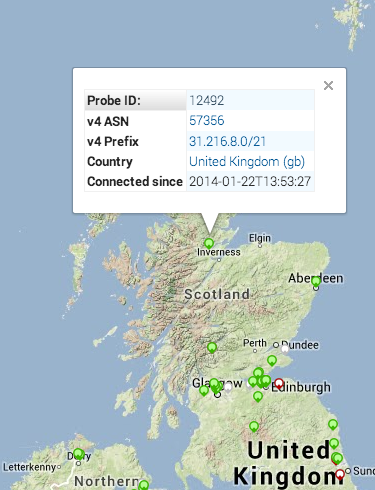
This has resulted in what is currently the most Northerly probe in the UK being brought online in Dingwall, not far from Inverness, thanks to the folk at HighNet. They’ve also got a few other probes from me, so expect to see more in that area soon.

Most Northerly Probe in the UK

HighNet aren’t connected to IX Scotland yet, but maybe now they’ve got access to this instrumentation it might help them make a business case to follow up on that.

I also issued a number of probes at UKNOF in Manchester last week and I’m looking forward to seeing where they turn up.

I’d really like to get some of the community broadband projects in the UK instrumented, such as B4RN and Gigaclear. These bring some of their own challenges, such as issues with equipment at the customer premises that can actually handle the available bandwidth on the connection! It would also be great to be able to draw comparisons in performance between the community fibre service and the slower ADSL service provided over long copper tails in those areas.

Reflections on UKNOF 27

UKNOF 27 - Manchester Central
Our name in lights!

What a week it’s been!

My week started in Manchester, where it was the warm up for what turned out to be the largest UKNOF meeting so far – UKNOF 27. In this case the “warm up” was the IX Manchester meeting, facilitated by LINX (who operate IX Manchester).

This is, I think, the first time that UKNOF and one of the regional interest groups in the UK have teamed up and worked to co-locate their distinct, separate meetings on adjacent days in the same venue. It might have been a bit of an experiment, but I hope everyone agrees it was a successful one and we’re able to co-operate again this way some time in the future.

Talking of the venue… what a venue!

UKNOF attendance has been growing of late, and so to protect ourselves against ending up somewhere that couldn’t cope, we eventually chose Manchester Central Convention Complex.

I remember going to help scout the venues for this meeting earlier this year. We looked at various places, small and large. Remember that last time we were in the North West (back in 2010 thanks to the kindness of Zen Internet) only 65 people attended. Even the most recent non-London UKNOF in January 2013 couldn’t break the 100-barrier (and that was with Tref hosting!).

But, during 2013 we’d also had two bumper meetings at 15Hatfields in London and could see that we are definitely growing as a community, so we had to think big, and so we went with the venue that we felt could cope best with the unpredictability.

Initially, we were somewhat awestruck, maybe even a little bit nervous, when choosing a venue like this. It hosts massive conferences, trade shows and events. It’s a serious venue.

But we needn’t have worried, it turns out we’d made the right decision, and the space happily scaled up from a 60-odd person IX Manchester meeting to the 200+ person UKNOF the following day.

UKNOF 27 turned out to be our biggest meeting so far.

…and not in London!

We had over 250 people register. Around 25 cancelled their attendance in the week leading up to the meeting, and around a further 20 no-showed on the day. We’d ordered catering for 210, a good guess I think!

I’ve honestly not heard a bad comment about UKNOF 27. We had some fantastic, interesting and original content delivered by our speakers from within the community. I can’t thank them enough. Without them, without you, there is no UKNOF.

The audio and visual support seemed to work well, but we also learned a thing or two which will be brought to bear at future meetings. The Internet access was nice and stable: we brought our own wifi infrastructure for the meeting, and used Manchester Central’s great external connectivity to Metronet as a “backhaul”. 8 wireless access points were used to provide adequate coverage across the rooms, where most meetings previously got by on two. As usual, fantastic support from Tom at Portfast for the connectivity, and Brandon from Bogons.net for our webcast, along with Will and Kay who do connectivity for large events such as CCC who helped set up the additional access points.

Why was UKNOF 27 so successful?

Er, good question.

It was certainly a very easy venue to get to, regardless of how you wanted to get there. Plenty of parking space, easy access to public transport and an international airport just a short train ride away. Possibly even easier than a London venue?

Did the simple act of holding UKNOF in a serious venue such as Manchester Central raise the profile of the event with those who were sat on the fence?

There’s no doubt that the content itself was attractive, especially if (the lack of) bandwidth use was anything to go by.

The food offering from Manchester Central’s own in-house kitchens I thought to be superb, hope others agreed! All prepared from scratch in-house, even the biscuits for the coffee breaks, a definite cut-above a shipped-in offering. I felt you could taste the difference.

Maybe the co-location with the IX Manchester meeting meant that some folk stuck around for the extra day (and vice-versa)?

There seems to be renewed activity in the Internet engineering arena in the North of England at the moment – partly touched on by Mike Kelly’s participation in a panel at the meeting, discussing the relevance of regional infrastructure and it’s role in balancing the distorted London-centric infrastructure that has long characterised the UK’s Internet development…

…maybe there really are more Internet geeks in the North than the South these days?

Or if we’re going to have that level of influence, it’s just that our thrice-yearly get-together of Internet geeks is coming of age.

That said, I promise that we’ll stay true to our mission of “distribution of clue” and keep our focus on grass-roots Internet engineering and development.

Thanks to everyone who attended, sponsored, spoke, asked questions, or helped us in any way to make UKNOF 27 the success it was.

For those of you who enjoyed us being in Manchester, the good news is that we’re looking at a potential return there in 2015.

UK ATC Delays – a case of “Computer says No”

Many folks will have read about the ATC delays being experienced in the UK today.

Sadly, a lot of the explanations have been rather technical, not surprising since they are coming from industry experts or from those working for ATC or airlines who have a good understanding of the industry and the jargon that goes with it (e.g. “sectors”, “flow control”, “slot restrictions”, etc.).

Air Traffic Control Principles: To maintain a good margin of safety, an air traffic controller can only manage (“work“) a certain number of aircraft at the same time, taking into account the amount of communication they need to make on the radio with the planes they are working and the phase of flight those planes are in (e.g. takeoff, landing, climb, descent, cruise).

To manage the amount of traffic the UK airspace needs to handle on a daily basis, the skies are carved up into areas known as “sectors“, slotting together like a big 3D jigsaw.

Sectors: A sector handling traffic which is “in the cruise” – has taken off, finished climbing and is in level flight in the general direction of it’s destination – can generally handle more aircraft than a sector which is working traffic that is descending toward it’s destination.

For example, it takes more work to direct an aircraft to line up with the runway in order to land (several radio transmissions over 10-20 minutes), especially in the cloudy weather we get in the UK, than to tell it to fly in a straight line for 200 miles (one radio transmission in half an hour).

As an aircraft goes on it’s journey, it’s handed off from controller to controller.

The pieces of this jigsaw are set up for the “worst case scenario” – the busiest time of the day, when the most aircraft are flying in the UK and the most Air Traffic Controllers are needed on duty.

Control Positions: The consoles you see the controllers working at, which include screens with radar displays showing where the planes are, and display output which helps the controllers organise the traffic they are responsible for, make a record of their decisions, and communicate with neighbouring controllers. This includes the “telephones” and the VHF radio system for speaking to the aircraft, which are integrated into the console at the control position.

Merging sectors (Band-boxing): At night, when less planes are in the UK’s skies, the traffic is less dense, and fewer controllers are needed. These sectors are combined together, known in industry jargon as band-boxing.

The radars, radios and telephone lines for all the different sectors being combined are re-routed to the control position working the band-boxed sector. This is done using control software, and I suspect it’s this control software which has suffered a failure and become stuck in “night mode”.

It can’t “un-bandbox” the sectors, and re-route the radio and telephone lines to the right place in the control room.

The Net Effect: Because of the failure, it’s not possible to un-bandbox the merged sectors, and delegate control of the airspace to a greater number of controllers. Going back to my first point, a controller can only work a certain amount of planes while maintaining an acceptable margin of safety.

If it’s not possible to have more controllers working the traffic, they simply have to make sure there are fewer planes in the same bit of sky at the same time. To do this, ATC uses a process known as Flow Control, which consists of setting very specific (to within a few minutes) take-off times for aircraft. Because we know a plane is going to fly at a certain speed, at a requested height, along a known route, ATC can work out where a plane should be at a given time, based on it’s take-off time.

If there is too much traffic expected in the same place at the same time, ATC will work out the soonest it could safely work the traffic and then work that backward into take-off times for each plane – the slot time you hear pilots refer to.

Therefore when you hear a pilot talk about missing our slot, they don’t necessarily mean missing their time to use the runway at the departure airport, but their allotted time through some point in the air, maybe a couple of hours into the future.

Obviously, when something like this happens, the flow control and slot restrictions become more severe, also you can’t just go on delaying flights indefinitely. Airlines must also try and do their bit to reduce the strain on the available ATC resources, and they will therefore start making tactical cancellations – for instance reducing the number of flights on a given route, especially if it’s a high-frequency route with a plane every hour or two. Maybe they will cancel 50% of the flights and transfer passengers to those planes which will still operate. This frees up a slot in the airspace to be used for a flight which runs less regularly and makes sure that route is still served.

Where airlines have a fleet of planes of different sizes, so these are the larger carriers such as BA, they may try and combine two flights together on one single larger aircraft (e.g. two Airbus A319s onto a single Boeing 767). Again, this makes more space in the skies.

If you’re travelling today, I hope you get where you’re going eventually. You’ll need a lot of patience though, and resign yourself to being delayed. Sadly, being delayed is one risk you take whenever you travel, and by whatever method you choose.

If you don’t really need to make your journey today, contact your airline and offer to travel another day, they may appreciate having one less person to carry and you will release your seat for someone else that might really need it.