When your staff are your best asset…

All stop on the West Coast yesterday, as a mahoosive signal failure at the important Motherwell signalling centre brought everything to a stand between the Scottish Border and Glasgow and Edinburgh. A number of people were stuck on trains in the affected area, which were unable to move for as long as three hours. Other trains were held at the station stop prior to entering the affected area, such as Carlisle.

One of the stuck people was comedienne Janey Godley, who appeared to be slowly losing her mind despite travelling in First Class, and tried to open up a 140 character at a time dialogue with the @virgintrains twitter person.

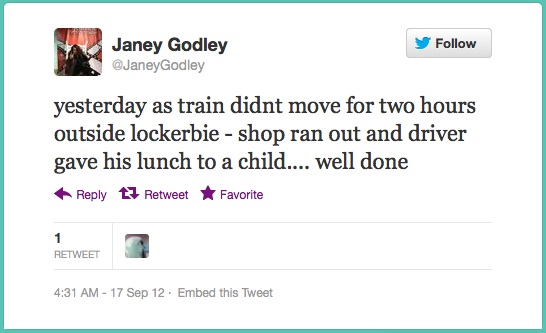
Eventually things got on the move again, and while Janey had to settle for sausages as opposed to “sex and mince”, today she did point out the kindness of the on-train crew toward the passengers during the extended delay…

Nicely done by the Virgin Trains’ On-Train staff, who seemed to put a human face on the extended delay. Good to see that staff morale is still relatively high despite the ongoing wrangling over the franchise. Talking of which…

As Virgin Rail Group has applied for a judicial review of the DfT decision to award the “ICWC” franchise to First Group, this has brought the franchise handover date itself of 9th December into question.

We’ve got the Branson offer to continue to run the franchise on a non-profit basis (donating profits to good causes) while the review proceeds.

However, the other option is that the DfT take control of the franchise until such time as it can be awarded and smooth transfer of responsibility can happen, not dissimilar as they had to do with East Coast.

But, ask yourself, is it a good use of public funds to incorporate a new entity to run ICWC on an interim basis (this includes hiring management, etc.), rather than accept Virgin’s offer to keep things on an even keel until a decision can be made.

As long as the VRG offer can be taken on a non-prejudicial basis, could this be delivering best value for the taxpayer?

In any case, spare a thought for the staff caught up in this…

Can you hear Steve screaming too?

Interesting article on BBC News about the impending iPhone 5 launch by the chap behind the “fake Steve” blog.

Definitely some valid points made, especially with reference to the leaks in the run up to the launch about how potentially unremarkable the iPhone 5 could be, that Apple’s share of the smartphone market that they helped to define is being thumped by the nimbler Asian companies’ Android handsets, and that Apple’s spend on R&D as a percentage of revenue is a paltry 2% under Cook’s leadership. There’s a good argument which says that for a company like Apple, it needs the yin and yang balance at the top – both the eccentric visionary to keep driving new ideas and push to take risks, and the number-crunching expert to keep the corporate feet on the ground once in a while, and stop the money running out. Very rare you find these qualities in the same person, if you ask me.

But there’s one comment which doesn’t sit right with me, and that’s the comment that the UI hasn’t changed in years, and that is somehow a bad thing.

I don’t know about you, but people who lead busy lives don’t appreciate having to start on a whole new learning curve just because they’ve updated their device. People like familiarity, which seems to be something Apple haven’t lost sight of.

The “familiarity” aspect is a huge selling point for those who don’t have time to to re-learn, or if you’re someone like my parents, don’t really want to have to re-learn, because they a) don’t much like change, and b) are a bit technophobic, usually because just as they get the hang of something, the UI changes on them.

But, I’ll go one step further. The entire smartphone market is, at first glance, pretty unremarkable now. They are all hand-sized rectangles with a capacitative touch screen on which you can read your email, a half decent point-and-click camera, and you can even make and recieve phonecalls.

So, does this give grist to the “upgrade the UI” mill? Maybe there’s some way of keeping both camps happy – like a “simple” and an “expert” mode?

As for Steve? I’d say he’s screaming and spinning in his grave.

“Snackboxes”: Cutesy, yes. Wasteful, probably.

I’m just heading up North on a Virgin Train (thought I’d better try one while I still can).

I ended up going 1st Class because it was cheaper than Standard, when booking in advance. Not that uncommon actually, and sometimes it’s even worth doing if it’s a couple of quid more expensive, because of the inclusives: light refreshments such as tea and coffee, and wifi access at no extra charge. Basically, you can sometimes get good value for money, and Virgin (and other train companies) get to put bums on 1st class seats which would otherwise go empty off-peak, and it reduces the pressure on the cheap seats.

In common with most train operators, the weekend 1st Class at-seat service is a shadow of it’s midweek counterpart: limited to tea, coffee, water and snacks. This used to be things such as (normal-sized packets of) crisps, nibbles, and biscuits.

Today, this has been replaced with “A little box of snacks” – about 2×3″. Now, it looks cute. There’s no doubt about that. There’s a childlike feeling about opening one for the first time.

But the contents are distinctly underwhelming:

  • The smallest bag of pretzels I’ve probably ever seen (and if you don’t like “sour cream and chive”, you’ll be left feeling a bit sour)
  • A micro-flapjack that would leave a hobbit’s tum rumbling
  • A pack of cream crackers and soft cheese
  • A continental “speculoos” biscuit for with coffee
  • A bit of Valrhona chocolate (yum)

I had the pretzels and the chocolate, as I didn’t really fancy the rest of the contents. The rest will no doubt go in the bin.

While I’m in no doubt that it makes inventory control much simpler (and may well be cheaper), it is effectively a reduction in choice for the passenger, and surely increases waste in an era when a huge part of companies’ social responsibility is dedicated to reducing their environmental impact?

Phone cameras: Apple continue to dominate

I was carelessly browsing through flickr’s camera stats, and I thought I’d go back and revisit the post I did 6 months ago, where I thought that flickr’s stats on cameraphone usage said something about the loyalty of the iPhone userbase.

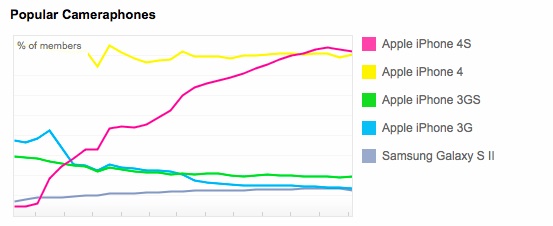
So, the latest breakdown of the most popular cameraphones used to upload to flickr is still dominated by Apple:

The 4S has now overtaken the 4 as the most popular camera, just in the past month, but 4 usage isn’t really falling off, it seems to have plateaued.

The long tail of 3G and 3GS continues, with the nearest Apple competitor, the Galaxy SII only garnering the same number of daily uploads as the 3G.

Now, if anyone from flickr is reading this, what would be interesting is a comparison of iOS vs. Android vs. Windows Phone devices, as it will be interesting to see how this changes over time, particularly as there seems to be just more and more feature parity and less USP across the smartphone market.

I also thought that it was interesting that uploads from cameraphones to flickr are altogether higher than dSLRs, with the iPhone 4S dominating, and have been for some time:

So, you are opted in by default…

Some of you may remember my post regarding concerns about how East Coast were collecting and managing customer data when buying train tickets online.

They actually responded very positively and I can confirm that their web forms have been changed to stop the compulsory collection of the more random looking pieces of information.

However, we never really got to the bottom of how I ended up opted-in in the first place. But, buying some more tickets this evening gave me the answer:

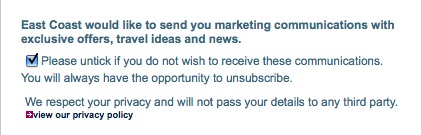
You are opted in by default and have to untick the box to opt-out.

This does comply with the letter of the law, which is that we are given a means of refusing (opting-out) of email marketing when buying a product or service.

But, this is not really in the spirit of the law, and not good/best practice for email marketing in the UK, which says:

“If the form has a checkbox to sign up for email communications then this checkbox must not be checked by default. The user must choose to opt-in rather than remember to opt-out.”

Tut tut.

Of course, I remembered to untick this time.

Planes, Trains, and a couple of bus companies from Scotland…

Well, the Great British Public have rallied around the underdog, as per usual, this in the Great Train Sale. There have been huge outpourings of support for Virgin Trains since the news that they would not be running the services out of Euston from December, and there is even an e-petition to urge the Government to look again at the decision which is gaining a lot of support.

It’s also going to be more than a co-incidence that Virgin Atlantic have announced a move into UK domestic operations the week after the news that the WCML franchise would be going to a competitor. Even though there has been speculation that this was on the cards since BA bought UK competitor BMI, and there must have been planning going on in the background, launching when they did has maximised publicity for the new VAA operation, riding the wave of publicity around Richard Branson saying words to the effect “We probably won’t bid for another rail franchise again, unless things change”. Because it’s diversified, Virgin can afford to “walk away”, or at least appear to, and at the same time deliver a parting blow to both the DfT and the incoming WCML franchisee, First Group.

Of course, being the underdog is nothing new to Branson – think of the “Dirty Tricks” affair with BA – so he knows how to play this role pretty well, and the man in the street finds it easy to get behind Branson as being a “people’s champion” versus the dull, bland corporates.

However, what happens next? Well, unless Virgin decide to back off, accept the franchise loss, and decide to compete in the air, it’s going to cost us (and by “us”, I mean the UK taxpayer) even more money:

If the franchise is debated in Parliament as a result of the petition, it will cost the taxpayer money.

If Virgin decide to appeal the decision, and take it to a judicial review, this will cost the taxpayer money.

If the DfT make a u-turn and decide to take the franchise away from First Group, and award it to Virgin, then First will likely want a review of their own, and/or seek compensation. Who’s going to pay for that? The taxpayer. Not First shareholders, not Stagecoach shareholders (remember, they own 49% of VT), not Richard Branson, who I’m thinking was evidently right when he dismissed rail franchising as “insane”.

The whole crazy privatisation, hashed together by the bungling Major Government, of Britain’s railways has cost the taxpayer billions, and delivered minimal benefit to the passenger.

The normal rules of a deregulated market do not apply on the majority of Britain’s railways. There is often no consumer choice other than “take it or leave it” for the majority of rail journeys, as only one operator provides a service. Many attempts at competition and open access have either failed (such as Wrexham & Shropshire), have been blocked because it threatens the incumbent franchisee, or are simply non-starters because there’s insufficient capacity in the infrastructure.

If a rail operator fails, then services aren’t allowed to stop running, because that would have disastrous consequences, instead the Government step in and constitute a quango to run the service, while the private company skulks off.

A bit like bailing out the banks when they screwed up. It’s already been done with the failure of Railtrack, and with a couple of franchises.

So, instead of competition and choice, we have an expensive raft of lawyers, consultants, and contract managers that has evolved to support our dysfunctional railway franchising and track access ecosystem.

For instance, because of the punitive blame-placing system of managing delays on the modern railway, there are teams of people known as “delay attributors” who trace train delays through the system, and work out how they were initially caused. Not so that the cause is avoided in future, so the delays are reduced, but primarily so that someone is “blamed” for the delay, so a settlement plan can push “pretend money” around between Network Rail and the train operators, because at the end of the day, it all likely balances out over time, and little real money actually changes hands.

This even costs money and time at the coal face. Example: A friend who is a Guard for a national operator was harrassed by their manager as to why their train took an extra two minutes between two points on the railway that their train didn’t even stop at. Of course, they had no idea why, because the train didn’t even stop there, and they were busy checking tickets. It left the previous station on time, and the train was on time the next station. Evidently, there was some pressure from a delay attributer on these two minutes even though they had no consequence for those on board the train. How is this a good use of our money?

Of course, this never really translates to benefit for the passenger (or the freight customer) – the various bodies involved in running the trains just point fingers.

There are a number of bodies, including the Bring Back British Rail campaign, who would like to see the railways renationalised, and they may have a point.

Ironically, during the latter years of BR, some elements of the business – such as Intercity – actually delivered a significant surplus. This in turn reduced the taxpayer burden on subsidising those services which required it – the benefit of an integrated company.

There have been attempts to build franchises which use this theory, such as the single First Great Western franchise – this used to be several seperate franchises, a profitable Intercity franchise, and subsidy-dependant commuter and rural services – the idea being a franchised operator can’t just cream off the profitable stuff, and there’s a resultant overall reduction in public subsidy for the commuter and rural services, being buoyed up by revenue from the longer distance services. However, given that First Group are now exercising the break clause in the Great Western franchise, allegedly as it’s no longer viable to pay the DfT to run the franchise (due to depressed revenues due to falling commuter numbers), even this hasn’t worked out quite as planned.

We’ve also got a laughable situation where it seems that a state-owned UK company cannot theoretically bid for a railway franchise, but at the same time we’ve got the commercial/international arms of mainland European state-owned rail operators who did, and now run UK rail franchises – Arriva (who also own Chiltern) are Deutsche Bahn, Abellio (behind Greater Anglia and Northern franchises) are Nederlandse Spoorwegen, and Keolis (who are part owners of Southern, SouthEastern, and TransPennine) are actually majority owned by SNCF. Does this consititute a net flow of taxpayer subsidy out of the UK?

This was recently highlighted in the Scottish Parliament – where you consider that ScotRail is 75% publically funded through subsidy – then why was this going to a commercial for-profit operator? Why could Holyrood not incorporate a Scottish state-owned non-profit company to run the service? Apparently, there’s some red tape in the 1993 Railways Act to deal with.

So, returning back to the WCML franchise: Branson is certain the First Group bid will result in an East Coast style bail-out. Now he’s competing in the sky, that may even give this a nudge. What if others follow Branson’s lead, dismiss railfranchising as “crazy”, and no-one wants to take on the poison chalice of the ECML?

If we assume for a moment that the new WCML franchise goes bump before the DfT can re-let ECML, does the Government end up running WCML and ECML?

Is that a foundation for re-nationalisation of train operations through the back door?

A new tax on Londoners…

Martin Addison [CC-BY-SA-2.0 (http://creativecommons.org/licenses/by-sa/2.0)], via Wikimedia Commons…and British city dwellers generally.

You don’t have to travel far in a city to find a self-storage unit. It’s the equivalent of garden shed, loft space, or garage to millions of people who live in cities, and the business experienced rapid growth in the UK in the early 2000s.

As part of “closing a loophole”, the Government will be levying 20% VAT on self-storage rentals from October.

Now, to paraphrase the Mayor of London, Boris Johnson, developers behind new build in London have a habit of constructing “Homes for Hobbits“, which usually means small houses or flats with little or no storage space.

If you live in a flat, you’ve no loft space or an “under the stairs”, and if you can afford to live in a house, there is a massive trend to convert the loft into an additional bedroom, “den” or study. So, you need somewhere to store all the things you don’t use regularly, but at the same time don’t want to get rid of – such as Xmas decorations, spare furniture, DIY and decorating things (that would normally be in your garden shed), and even things such as formal clothes, or seasonal clothes, because your flat is so small there’s no space for “idle” stuff.

The basic gist here is that the average Londoner, living in the average London house, needs to use self-storage, or has to live an increasingly disposable lifestyle. This is borne out by the sheer number of self-storage facilities in London and other cities, compared to elsewhere.

Imposing VAT on self-storage is feels like a tax on already expensive city living. The other choice is to live an environmentally unfriendly throwaway lifestyle.

This is without even considering the impact on the self-storage business in terms of people’s livelihoods.

I wonder what the Mayor’s position is on this new tax on Londoners?

Virginity Lost. First to gain Intercity West Coast Franchise…

Well, the fat lady has sung. Virgin Trains did not regain the franchise to run West Coast mainline trains out of London Euston up to Birmingham, the North West, and Glasgow. The franchise will be taken over by First Group in December this year.

I have mixed feelings, as Virgin did a lot of good things, particularly to attract business travellers out of their cars and away from domestic air travel, and their excellent use of Social Media, but they also did some pretty iffy things as well, and like so many Virgin companies, place form over function, style over substance.

But, what does this mean to you?

There’s been a lot of claptrap in the twitterverse and blogosphere (and here I am adding to it!), emotional people saying “I’m never getting a train again”, and lots of misinformed comment about the service changing overnight, the “new longer trains being taken away”, and people seem generally confused, given they seem to think that First won’t use the Pendolino fleet but draft in some old tosh from one of their other franchises, or that the journey will suddenly go back to pre-WCML modernisation speeds.

Here’s a quick list of things to help you through the transition:

Should I expect a change overnight?

In a word: No.

Will the Pendolinos and Voyagers be taken away by Virgin when they go?

No. The existing rolling stock will stay on the West Coast route. Many of the special features which make the Pendolino speedy only work on the West Coast routes out of Euston. Keep in mind that Virgin only lease the trains. The lease will be transferred to First. The trains will be de-branded/re-branded, and eventually re-painted in First’s colours.

I’m a regular passenger and I like the Virgin staff I see when I travel, what happens to them?

The operational staff, both frontline and back-office, will stay in their jobs for the immediate future, transferred to the new franchise.

Their employment is protected under TUPE. If they are uniformed staff, the colour of their uniforms will change, but the faces will mostly stay the same. If people choose to leave because they preferred working for Virgin, and don’t want to work for First, that’s their decision. The most likely changes are at HQ level, in senior management.

First is really a “brand” in this sense, as is “Virgin”, and it’s the people who are actually running the franchise on a day-to-day basis who make the difference.

Of course, if senior leadership from the parent company is poor, this would be a negative and foolish thing.

Will the timetable change?

Maybe, but initially, no. The format of the timetable, service frequencies, stopping patterns and train lengths are largely laid out in the franchise requirements from the Department for Transport, and are changed gradually over time in line with changes in passenger demand and traffic patterns.

First have pledged to add further services on the West Coast, including restoration of direct services from London to towns which had lost service during the Virgin franchise (and previously under nationalised BR), such as Blackpool, but remember that such extras are actually being enabled by taxpayer-funded infrastructure improvements (such as electrification), and not just by First Group. It’s likely that these extra services and trains would have also happened under Virgin’s management.

Will journey times, which Virgin have brought down, increase under First?

No. The same trains will run over the same tracks, driven by the same people. Journey times should stay roughly the same.

But Virgin have just introduced new longer trains! First will make the trains shorter and increase overcrowding!

This is just rubbish and spreading FUD.

The entire Pendolino fleet is staying for the forseeable, including the 11-car Pendolinos which have been launched during 2012, likewise the Voyager fleet.

Indeed, the plan was for the franchise to change earlier in 2012, and the new franchisee would have deployed the 11-car trains, and not Virgin – at which point some of the more fickle among you would have no doubt been singing First’s praises for fixing the overcrowding with their longer trains and slagging Virgin off for keeping you “cooped up in cattle trucks”.

However, the Virgin franchise was extended and they worked with Alstom (who build and maintain the Pendolinos) to deliver the 11-car project, which was actually done through a seperate Virgin company (Virgin Rail Projects), to get the much needed extra capacity in service.

Will the trains breakdown more often?

Unlikely! The trains are leased, and include a maintenance package from the manufacturer (like a new car) – Alstom in the case of the Pendolino, and Bombardier in the case of the Voyager. The maintenance regime, the depots which do the work, and the people involved, will stay the same when the franchise changes.

Will the fares go up?

Not specifically because of the franchise change. But rail fares do go up over time. First will operate a similar range of tickets to those provided by Virgin. Certain levels of ticket have to be offered as a bare minimum anyway. What may change is that some of the cheaper offers, which are not regulated by the Government, but yield/demand managed by the franchisee themselves, may change in terms of price paid or number of seats offered at the cheaper prices.

But, remember that First Group have shown that they plan to offer a number of better value fares as part of the franchise bid.

What about the inclusive offering in First Class (food, drink, etc.)?

First offer complimentary refreshments to people in First Class on their other Intercity franchise – Great Western. This is basically unlikely to change, but what is offered may change over time (such as the complimentary food offered, and complimentary alcohol). For those who don’t remember, the catering offer has changed quite a bit during Virgin’s time running West Coast. The First bid has also pledged to improve onboard catering to all classes, but we don’t really know what this looks like as yet.

Apparently, First have already been talking to Alstom about potential modifications to the Pendolino fleet with respect to catering facilities, and there are rumours circulating that standard class catering will be reduced to a trolley service. But I suspect the 1st Class morning fry-up is not under threat, though you never know, you might end up having to pay extra for it.

Will the trains become dirtier?

I doubt it. First actually have a fairly good reputation for train presentation. The change when First took over the Thameslink franchise was noticeably positive, for instance. The smelly, dirty, graffitied trains, still containing original BR interior decor and seating trim, were very quickly cleaned up by First.

The Pendolino is uncomfortable and cramped. Will First change this?

Well, the Pendolinos are over 10 years old now, and may be due an interior facelift. We already know that both Virgin and First had been talking to Alstom about alternative interior configurations in the run-up to refranchising. Maybe First could refit the interiors and make the seats more comfortable and line up with the windows a bit better!

Will Virgin Trains’ great Twitter update service go? They’ve been a huge help to me when there’s been disruption.

It would be a rather foolish move by First Group reduce the level of social media activity of the West Coast franchise. Studies have shown that participation on services such as Twitter increase customer forgiveness during disruption because the timely flow of information helps them make informed decisions to change their plans.

In terms of style, I think the current @virgintrains Twitter staff do a fantastic job, and present a credible front for the operation. They don’t fall into the normal social media trap of asking banal questions on a “slow news day” like “What are you having for dinner?” which damage the credibility of the real information.

I hope that the social media team at VT are transferred to the new franchise and left to get on with what they do, as they do a great job of it.

The performance and satisfaction on another First franchise is really low. Will the performance drop to similiar levels with First taking over West Coast?

Probably not measurably. Low performance levels are more frequently due to route-specific conditions such as age and condition of rolling stock, tracks and signalling. As none of these actually change overnight (same tracks, same trains, same people, just different colour trains and uniforms) at the point First take over West Coast ops, there shouldn’t be a noticeable change in the performance of the service.

Whether the high performance of Virgin in the latter days of it’s franchise (and remember, this was after a terrible start – because the infrastructure was ageing and suffering from underinvestment) will be maintained throughout the First franchise remains to be seen. It largely depends on First’s business plans and strategies for West Coast. Anyone got a crystal ball? Divination rods?

I’ll try and update this as more info is known, or more frequently asked questions are seen…

You know when you’ve been Blimped

What’s that noise in the sky? Is it a flying lawnmower?Goodyear Blimp

What about that funny cigar shape? A UFO?

If you’re in London right now, it’s more likely to be the European Goodyear Blimp – “Spirit of Safety I” – operating a major flying campaign in the London area.

With the massive summer of events and sports in London, it’s hardly surprising. As well as advertising tyres, the Blimp also carries TV equipment to help cover major sporting events from the air. The blimp will be with us all summer long.

It’s a daily sight in my neighbourhood at the moment, as I’m just on the edge of London City Airport’s airspace, which the Blimp has to skirt around on it’s way from it’s London moorings at Damyns Hall airstrip in the Dagenham Marshes, to Central London.

Indeed, some people think the blimp is following them around, as it buzzes the skies of London.

“The Goodyear Blimp followed me home…”

“Goodyear blimp over Leigh-on-sea. Does anyone else find airships a bit weird?”

“Why does the Goodyear blimp keep hovering round where I can see it. It freaks me out a bit.”

the Goodyear blimp just went over my house. idk why but it terrifies me & i get really nervous whenever i see it.”

I sympathise with these last two. I used to be terrified of the damn thing too, and while that has long since passed, I still find it fascinatingly eerie.

When I was little, the Goodyear blimp used to use the airport near the house where I grew up as it’s local mooring. I must have been about 5, enjoying a summer Sunday in the back garden, when the blimp appeared. Back in the 1970’s the European blimp, “Europa”, was silver and way noisier than today’s Spirit of Safety with it’s little engines.Why was it hovering over my parents’ garden? Spoiling my afternoon!

Well, I ran in the house like a crazy person. And locked myself in the bathroom. Probably because it was the only room in the house with a lock on the door (so it couldn’t “get in” – we’ll ignore the fact it would have to get in the house and up the stairs for now), and the frosted glass meant it couldn’t “see me”.

So, I understand your apprehension when it feels like the blimp is stalking you

How do you feel when you see the blimp overhead?

East Coast Respond on Data Collection Concerns

I’ve now recieved a positive response from UK train operator East Coast in relation to the data collection and retention concerns I had after booking a journey with them recently.

The general gist of it is that the mandatory collection of marketing data like age, number of children, etc., were “not as specified”, and it is “being fixed” so that it’s no longer mandatory to enter these details just to change your account data, such as your email address, or opt-in/out status of marketing emails.

They don’t, however, consider the information collected as excessive, as long as it’s optional and you volunteered it in the first place.

But at least they have said they are fixing the inappropriate mandatory fields in their webforms.