I’ve just come back from a fantastic weekend in Northern Sweden. Inside the Arctic Circle. Landing and taking off from a snow-covered runway at Kiruna Airport. Mostly eating reindeer.
Looking up from time to time, so I’ve been able to take amazing photos like the one above.
I’ve learned how to ride a snowmobile. I’ve also learned how to crash a snowmobile. Fortunately, landing in a couple of feet of snow is a cushioning experience, and the only bruises I came away with were to my pride, and to my wallet because a small plastic fairing got broken.
I’ve glid across deserted frozen rivers, almost silently, moved by nothing but dog power.
I’ve spent a (very chilly, -29C!) evening with top Aurora photographer Chad Blakley, picking up tips on how to get the best out of your Aurora photography, and how to set up and look after your camera in freezing conditions.
When the temperature gets down below about -15C, ice forms on any exposed hair (such as eyebrows and facial hair), up your nose, and in my case, sometimes on my glasses, as the moisture from your breath freezes.
The whole experience has been fantastic, and everyone we dealt with has been friendly, welcoming, and shared their love of the amazing area around Abisko.
We arranged the trip through Weekend a la Carte, who gave us first class advice in terms of being prepared for the Arctic, and put together a seamless experience for us.
What an amazing experience. Brilliant. Coming home to a damp 11C feels positively balmy.
The spokesperson for the theatre involved really hasn’t got a clue – offering to donate it to a museum or railway preservationists – but at the same time saying that “Gordon needs to be kept indoors as he’s made of wood”.
Most museums wouldn’t want “Gordon”, because it doesn’t represent anything, because it’s just a wooden stage prop – however painstakingly detailed.
As for railway preservationists, they have enough problems finding enough space to keep real trains, made of metal, that can actually pull coaches and make money, under cover to keep the worst of the elements at bay. The majority of preserved railway sites have either no covered accommodation at all, or a desperate shortage.
What was the production thinking?
I suggest that “Gordon” would be more at home and appreciated in a kiddies play centre.
Jessops was the sort of place you would go to buy camera stuff if you needed it quickly and couldn’t wait for it to be delivered, i.e. you were desperate for a particular widget that they happened to have in stock. The other reason you might visit Jessops is to check something out, and then go and order online for a better price.
For instance, I like photography. Before I headed on holiday at the end of last year, I thought I could do with a good wide-angle lens for my DSLR. Running out of time before the trip, I had looked at the local Jessops. Compared to Jessops’ walk-in price, the lens was over £150 cheaper online and still delivered next working day.
The professional market spurned Jessops for being too consumer oriented (with a limited in-store range and high prices) in favour of independent and online shops (or small, specialist chains like Calumet), and the bottom has fallen out of the consumer point-and-shoot market because almost everyone’s mobile phone has a half-decent point-and-shoot camera packaged in it.
Jessops did have an online store, but the prices weren’t significantly better value than those offered in the high street, and not competitive against other online retailers such as Amazon.
That’s what killed Jessops. They were expensive, failed to move with changing habits, and ended up appealing to a very fickle and limited audience.
The City of Sheffield is nestled in the beautiful Peak District, with plenty of opportunity to go for pleasant walks among the reservoirs in the Derwent Valley and visit cosy countryside pubs. However, when it’s raining, things are different. Just what can you do when it’s raining in Sheffield?
1) Get wet.
2) Nap.
3) Wake up your friend who is an F1 (first year) Doctor before she’s about to do a night shift on New Year’s Eve.
4) Get wet while shopping.
5) If you don’t want to get wet while shopping, you can go and have your soul crushed while shopping in the dry at Meadowhall.
6) Take a trip to Eyam, according to the Peak District Online web site. (Plague not included, and I strongly suspect you will still get wet.)
7) Go and eat Bakewell Tart in Bakewell itself. Along with everyone else sheltering from the rain.
In the glory days of the railway, the British Rail restaurant car breakfast was something of a treat. Cereals, toast, juice, and full English – offered to you “service Anglaise” from a tray, so you could get what you wished. They even had kippers.
Even despite “modernisation” of the BR buffet car under InterCity in the 1980s and early 90s – think along the lines of moving away from Mr Kipling cakes and Maxpax coffee to croissants and the chewy microwaved burger – the Great British breakfast was left well alone, lest the Great British businessman kick up a stink…
The hair is a dead giveaway as to which era this BR breakfast belongs! Photo: NRM
For a while, this even survived into privatisation, most notably perpetuated by the late GNER: “Great” for so many reasons, and not just the fact that even when travelling in the cheap seats one could still sit in the restaurant car and eat real food at 100mph-plus, as I often did.
Where freshly cooked food is still available on British trains, the current trend is a move away from the classic restaurant car to an at-seat service for 1st Class passengers only, called “complimentary” by the train companies, as opposed to inclusive, so they are able to weasel their way out if the service can’t be provided as advertised. Generally, this service includes a cooked breakfast, light food across the day and sometimes a cooked evening meal, which is what Virgin Trains provide on their routes out of London.
I’d recently travelled from London up to the Northwest, and by a quirk of the UK railway fares structure, it was one of those trips where by booking in advance, it was cheaper to go 1st Class as opposed to Standard. “Great”, I think, it’s a train where they serve breakfast, and while I didn’t expect it to be anywhere near as good as in days of yore (as they never are!), I’ll happily admit to looking forward to it.
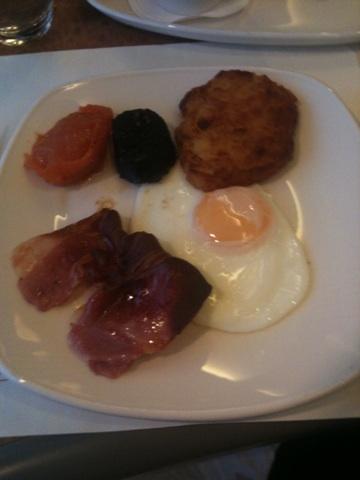
So, you can imagine my disappointment when I was offered “the last rasher of bacon”, which was overdone to the extent of being tooth-breakingly crispy – you couldn’t get a fork in it, a “grilled” tomato almost reduced to mush, some overdone black pudding, a dry-looking hash brown, and a rubber egg. I took one bite, and pushed the plate away, but not before I got a pic of it, so disappointed to be served such obviously second-rate tosh…
Hope you like your bacon crispy?
“No more bacon…”, I was told. It seems that the people sat further up from me could only be offered similarly incinerated sausage. I asked one of the crew to take it away, and I tweeted the above pic to VT’s (excellent) Twitter desk, to see what they had to say…
Either my rejection of the burnt offerings, or the message to the Twitter desk, got someone’s attention, as a few minutes later, this arrived…
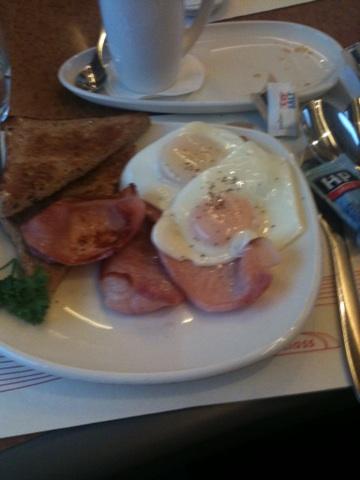
Bacon and eggs, was it?
“No more bacon”, apparently. Hmm. I didn’t notice us stop to pick some up, either.
But, nice save of face by the crew in the end, though the sad thing is that I had to complain before something was done. Really, that overcooked stuff shouldn’t have been served in the first place. Surely the person with the tray noticed what she had was burned? Wasn’t she ashamed to serve it?
This isn’t the only beef about the alleged “1st Class” service offered on that train. Things could have been done with a bit more style, and thought for the passenger.
For instance, there seemed to be an assumption by the crew that people sat in 1st Class knew what was on offer, and what to ask for. There were no menu cards, and no explanation offered about what was available.
One of the crew members walked past with a closed up solid-sided trolley (like an airline food trolley) mumbling “Anything from the snack trolley?” – wouldn’t this have been better if the trolley was more open plan so we could see what was available, or if the person had told us what they had inside the trolley?
Later in the journey, between Crewe and Warrington (and by this point, we were 30 minutes late because of a signalling problem near Stafford), the crew were starting to collect cups and things in, it looked like they would change catering crew at Preston so they were clearing away, and putting out fresh cups, etc.
At no point did anyone ask “May I clear away?”, or “Can I get you anything else?” – your place setting was just cleared away, seemingly with an unspoken message of “Right then, that’s all you’re getting”.
Unfortunately the train then ran into more trouble between Warrington and Preston (faulty windscreen wipers on the North end cab, beaten into submission by the relentless Northern rain, it seems). Initially, the train was going to be reversed by manoeuvring around a triangle of junctions (for North American readers, you’ll know this as a “wye”) just south of Wigan, so the good cab would be on the “correct” end of the train for continuing toward Glasgow. That would have taken another 30-40 minutes. Eventually, after some dithering, this reversal was abandoned and the train continued to Preston and terminated there, an hour late, where it could be swapped with another Pendolino.
By this point, after a 30 minute-plus delay, passengers in Standard are entitled to certain complimentary things (water, tea, coffee, until it runs out) from the Shop. Were those of us seated in the “good seats” taken care of during this period? Unfortunately not. Laying on some tea and coffee would have been fairly simple, and would have given the impression that our custom mattered to Virgin Trains, but it didn’t happen.
You’ve got to question why this is? Are some Virgin Trains’ staff feeling undervalued and demotivated? Uncertain of the future following the franchising fiasco? Or poorly selected and trained? Or simply only allowed to follow the prescribed service, bound by process and discouraged from using initiative?
Maybe it was summed up by a nearby passenger who said to me “If you think that breakfast was bad, you should try the evening meal. East Coast have better food.”
Are us Brits too backward about coming forward? Or is the fact that it is “complimentary” somehow meant to remove expectations of a decent service?
People petitioned hard for a rethink for Virgin to retain the West Coast franchise back in the summer. I agreed that this was the sensible thing to do, especially once the previous franchise process was declared invalid, it made sense to let Virgin continue. Now that’s happened, you’d think they would be wanting to reward passengers for showing such faith in them, and that the support was well earned, right?
Virgin’s basic railway product out of Euston isn’t horrific, with frequent trains and quick journey times (when it’s not blighted by engineering work), but with a little more attention to detail and some effort (and lining the seats up with the windows!), couldn’t it be really, really great?
Disclaimer: I should probably note that I am an ex-UK railway employee, having worked for BR in 1994/1995. That means I’m used to the consequences of disruption, but it’s how you handle it that makes the difference. Note that I pay full price for my tickets these days, this one included.
The folks over at Virgin Trains are well-chuffed that they are going to continue to run the West Coast Mainline on a “caretaker” franchise until 2014.
The decision, along with the promise of a review of rail franchising in the UK, also seems to have restored RB’s wavering faith in the system, as he is now appealing to the public for ideas to help Virgin win the 2014 competition.
So, I have a suggestion…
I’m really not a fan of poor industrial design, and think the Pendolino contains a number of design faux-pas which negatively affect the passenger experience, which I’ve written about before.
But, the biggest of these has to be that the seats don’t line up with the windows.
Despite this being cracked by railway engineers as long ago as the 1900s, the view from the window seems to have become a forgotten talent when it comes to putting together modern trains such as the Pendolino.
Fixing the existing problem on the Pendolino won’t be easy. It has significantly less window area that it’s predecessors (or the Voyagers that Virgin also use). Maybe a more sympathetic reconfiguration of the interior, such as moving luggage racks to positions which don’t have a window, will make things better for the existing equipment, which will be approaching it’s mid-life at franchise renewal time.
But, it needs to be one of the things built into the specification when ordering new trains in the future. It will improve the passenger experience by making the train seem more spacious, and help combat the travel-sickness some associate with travelling on the Pendolino.
So, a view outside. Maybe that’s the biggest single improvement that Virgin Trains could deliver. Make the #seatslineupwithwindows.
I’d been watching a transport documentary (on one of my pet hobby horses of rail privatisation) which had been uploaded to YouTube, when one of the “recommended” videos caught my eye.
It was a British TV documentary from 1991, following the colourful characters who worked on the London-Leeds train service at the time. I’d lived in Leeds for a spell around that time, and so some of the faces in the programme were familiar to me, as I’d encountered them as I’d used the trains in the area.
It was gutsy for the time (long before the boom of reality tv) that the BR publicity people let the TV crew have such direct and unfettered access to front line staff, who were allowed to freely express themselves to the cameras, especially as producers were fortunate during the period they were filming to catch British Rail suffering one of it’s most embarrassing moments – the “Wrong Kind of Snow“, which crippled many services for over a week.
They got to experience delays, breakdowns, and the sight of a driver climbing into a plastic bag to protect his lower body from draughts and leaks as the planned state-of-the-art loco was replaced with an older engine from the 1960s!
Toward the end (at 47 minutes), a time-served Conductor glumly predicted that 20 years from now, we’d be sat here wishing that we’d invested heavily in improved railway infrastructure.
(I’ve embedded the programme in full, or you can use the link above just to see the “prophesy” – haven’t got a clue why the embedded video won’t start at the 47 minute mark. Answers on a postcard…)
21 years on, as we battle to keep our railway infrastructure up to date and able to cope, it’s pretty damned obvious he was right that we should have spent the money back then, rather than delaying and delaying.
So many of the railwaymen in that programme were older and approaching retirement. I know that Trains Inspector Peter Kirton only passed away last year, for instance – he was an interesting bloke and published a few books during his retirement about his railway experiences.
I wonder how many of these characters are still with us, and might say “Told you so…”?
I was reading this article in the Metro (the free paper you get at railway stations, for the uninitiated) about how the once mighty supermarket Tesco was having a rough year (issuing profits warnings, that sort of thing), generally falling out of favour with the British shopper, who seemed to have been neglected while senior Tesco management were focused on growth at all costs, especially internationally.
I don’t like Tesco, and generally avoid shopping there. Here’s a couple of reasons why:
As the article says, it’s a fairly dull and uninspiring experience.
The shelf-edges at a Tesco are heavily cluttered with promotional signs (known in the trade as “barkers”) advertising “special offers” – it’s often hard to find what you want in the morass of brightly coloured shelf-edge clutter.
When you’re stuck for a quick lunch and the nearest option is a Tesco, the pre-packed sandwiches are dreadful – a bland, rather un-inspiring selection, and what’s more, they tend to use meat from non-UK suppliers – for instance “Bacon from the EU” (could be Brit, I suppose!) or “Chicken imported from Brazil and/or Thailand”, presumably because it’s cheaper than supporting British producers? Given the choice, I’d avoid these.
Tesco don’t seem to be focused on doing one thing well. They seem to be trying to be everything to everyone.
There are probably other reasons why I’m not struck on Tesco, but these were the ones which immediately sprang to mind when I read the article.
If you want a no-nonsense, bland shopping experience to pick up your essentials, that’s something Aldi do really well. Tesco don’t appear to have responded enough to the changing market, and seem rather stuck in the 1990s.
Following on from yesterday’s post on the upcoming ITU-T WCIT conference, and what that might mean for how you can use the Internet, and how much you have to pay to use it, Google have also launched their own #freeandopen campaign, with this video which is their take on what top-down Government regulation could mean for you…
A little known fact is that you can buy an extra seat from the airline when travelling. This is commonly used by musicians who don’t wish to check valuable musical instruments into the hold, and more recently to accommodate bariatric passengers who can’t fit in a single seat.
Those in the know also book extra seats to make long haul journeys in economy a little more bearable – we all know the wave of relief when the announcement says “boarding complete” and you’ve got an open seat next to you.
But, the airlines have tended to not like you doing it unless you really have a need. Depending on the airline, the extra seat can be cheaper than the seat you’ll actually be sat in (no meals, no extra bag entitlement, etc.), so it loses them some revenue.
Virgin Atlantic have decided to market the idea of extra seat, but it’s not quite the same concept. In this case, they are only bookable from 72 hours in advance – i.e. when Virgin know the plane is or isn’t going to go with empty seats, and they can be as cheap as £99 per flight.
In theory, it sounds like a good idea – by paying a fee, you can be certain you’ll have a bit more space, and Virgin get a little bit of money for that seat which would otherwise have gone empty.
I’ve not flown Virgin now for over two years, and that means I don’t have any status in their frequent flyer scheme anymore (I was Gold for about 8-10 years). Giving away “Seat Plus” to a Flying Club Gold member would be a fantastic perk, wouldn’t it? Don’t know if they are planning on doing it though.


 Mike's Twitter Overflow - Tech, Travel, other stuff