Want to book a train ticket? Then we need to know how many children you have…

…at least if you’re UK train operator East Coast.

I thought nothing of booking some train tickets online. I even got a decent deal. I doubt I could have done the journey cheaper in the car. They wanted me to register with the site, but then, most train companies do. They gave you an option to opt-out of email, which I took.

So, you can imagine my surprise when the next day, I got an email from East Coast, which started with “Now that you’re registered with us, we’ll be able to send you exclusive offers by email…

Erm. No, you shouldn’t be…

So, I thought I’d log into the East Coast website and check my communication preferences.

Not only did it show me as being opted in, but in order to untick the box and opt out, you have to complete some mandatory information in the “My account” page, before it will save the preferences and unsubscrive you from their mailshots.

What sort of information is it asking for?

  • My nearest rail station
  • My year of birth
  • How many children I have and how old they are
  • What the purpose of my journeys usually is
  • Who else I buy train tickets from

Now, having to fill this irrelevant information in just to change your preferences and unsubscribe from a mailing list, seems a bit excessive, don’t you think?

Note that you don’t have to give any of this information when ordering the train ticket itself (otherwise I’d have gone to an alternate online ticket seller, if I’d have known), just if you need to change anything in your account.

Yes, it’s very obvious that they are harvesting this information to build market intelligence, but this should not be collected on a mandatory basis.

I also tried the “Unsubscribe” link in the marketing email they sent, however that seems to have no effect on the preferences shown in the account on their website, which still show me as opted in.

Such an attitude to collection and retention of personal data seems a bit cavalier, doesn’t it?

I very sensibly used a + sign and token in the email address I used when signing up with East Coast, which makes the email address they use to reach me unique to them. So if they are seriously cavalier (i.e. stupid enough to sell it on to a third party) then I know whodunnit.

(Another irony is that the input sanity checking in their email contact form won’t accept a + sign token, of course, while their website will as  part of a username.)

It seems East Coast may find themselves foul of the Email Marketing Regulations and the Data Protection Act:

  • Sending marketing email which has not been asked for.
  • An unsubscribe mechanism which appears to be ineffective.
  • Mandatory collection and retention of irrelevant and excessive data.

I had a quick chat with a very helpful person from the ICO helpline yesterday, about how to approach the complaint, they agreed that it didn’t seem right that one had to provide such personal data in order to change one’s email marketing preferences, and told me to conduct all communication with East Coast in writing and keep copies of everything.

I’ve written (yes, snail mail!) directly to a suitably senior bod at East Coast explaining my concerns, and I’ll let you know what I hear.

Flowery marketing adjectives gone wrong

If you live in the UK, you’ll know the purple phenomena which is Premier Inn, advertised by that jolly Lenny Henry. (He’s a very tall chap. I wonder if they have a special bed for him when he stays?)

They actually do well at providing a reasonably good and consistent hotel product, something which the UK has long been lacking. Remember we’re talking about the country where you could end up in an antique hotel complete with rattly plumbing, school-canteen food, and that epitome of UK hotel kitsch, the Corby Trouser Press.

However, the warm, fuzzy, “I know what I’m getting”, brand consistency which comes with Premier Inn, also comes at a cost: There’s a marketing department back at Premier Inn Central in Dunstable, which feels the need to use lots of adjectives. Fairly standard marketing practice, but it’s almost like it’s there for the sake of it, and often downright odd.

My current cringe-worthy favourite is from their “grab and go” breakfast, or whatever it is they call it. It stood out as being odd when I first saw the flowery prose, talking about grabbing:

“A Costa Coffee and a baked croissant“…

The first thought that came into my mind was “Baked as opposed to what?”

Poached? Steamed? Deep-fat fried? The mind boggles.

Some copywriter in the marketing department just had to put in an adjective.

Yes, it made me pay attention to their “baked croissant”, so maybe it worked, but it’s just bloody weird when you read it.

Beginning of the end for IRIS?

When I was travelling internationally very frequently, I was a big fan of the UK’s IRIS recognition deployed at some of the busier UK airports. I probably still am, actually.

The system used high defintion photography of your irises, as unique as a fingerprint, as a replacement for showing your passport to an Immigration Officer. It allowed you to cut out a lot of the queueing, and most users were frequent travellers, everyone tended to know what they were doing!

It also didn’t depend on presenting a passport. All it used was the iris photography.

However, it looks like the system’s days are numbered – the IRIS booths in Manchester and Birmingham have been switched off. The booths at London airports (Heathrow and Gatwick) will be operating until at least after the Summer Olympics.

The UK Border Control say they are “reviewing their biometric technology”, which means switching off this really useful system.

I guess I’ll be back to queueing for a booth, waiting for ages, looking at posters containing “tougher checks take more time” hectoring by the authorities.

BBC News Story

Torrential Tannoys – can’t we just have a quiet life?

They say life imitates art, and one area I think this is true is in the growing number of speakers blasting out banal “information” tannoys. If you think of any fiction set in the future with some controlling regime (1984, Brave New World, Blakes 7), there are droning announcements blighting the lives of the citizens as they try to go about their daily business.

Anyone who uses public transport in the UK should be able to relate to this – the never-ending torrent of automated announcements that seem to bury useful information (like which station is next) in a stream of verbose drivel (to mind the gap, take our stuff with us, and remember to breathe).

Is “tannoy” really a portmanteau of “to annoy”?

Continue reading “Torrential Tannoys – can’t we just have a quiet life?”

WCML Blocked at Bletchley 3/2/2012: How do I get to…

I see that the @NetworkRail, @LondonMidland and @VirginTrains twitter folks are having a tough day today.This is the train we need to rerail at #Bletchley, with all w... on Twitpic

To use railway speak the “job is stopped” (i.e. no trains can run) through the Bletchley area because of this locomotive coming off the rails in the middle of the night last night. Apparently, the driver had to be taken to hospital.

This has had the effect of meaning no services out of London Euston getting further North than Tring, and services heading from the North to Euston getting beyond Milton Keynes.

If you can avoid travelling today, it’s probably a good idea to put off making your trip. It’s going to take a long time to get the line re-opened. You can see that it’s derailed across two tracks, plus the overhead wires which supply electricity to the trains have reportedly been damaged too.

Services are going to be disrupted all day, and most likely into the weekend as well.

There are a lot of folk asking on social media how they can work around this if they need to make the journey. There’s lots of redundancy in the rail network, but the alternatives aren’t always the most obvious.

Getting the Virgin train in to Milton Keynes if you’re heading for London is probably the worst option, as you’re then looking at road transport from Milton Keynes to somewhere like Luton or Aylesbury to get around the disruption.

A number of train operators will be accepting tickets on alternative routes, including those that would normally only be valid on a Virgin train. Please look at the National Rail page to check for these. Virgin have also released some very clear maps of alternatives.

Here’s a basic rundown of my recommendations for alternatives:

London – Scotland: East Coast from/to London Kings Cross, changing at Edinburgh, is likely your best bet.

London – Carlisle: Probably best on Virgin to Birmingham New Street, and then proceed as for Birmingham, on Chiltern. Going across to Newcastle or over the S&C to Leeds is likely to be slow, but is also an alternative, and one of Virgin’s own recommendations.

London – Preston: Again possibly stick with Virgin to Birmingham, and change for Chiltern to Marylebone, as getting across to Leeds from Preston (via Halifax) while one of Virgin’s recommendations, may be slow.

London – Birmingham: Chiltern Trains – Snow Hill or Moor Street to/from Marylebone, direct train, at least 2 trains per hour, approx 1h45 journey time. Or, First Great Western Paddington-Reading, changing for Cross Country Reading-Birmingham.

London – Coventry: First Great Western Paddington-Reading, and change for Cross Country for Reading-Coventry, or Chiltern to/from Marylebone, change at Leamington Spa.

London – Nuneaton: East Midlands Trains to/from Leicester, changing for connections to Nuneaton. This may also work for Coventry.

London – Stoke-on-Trent/Crewe: East Midlands Trains to/from Derby, changing there for Stoke-on-Trent/Crewe, or Chiltern Marylebone to Leamington Spa, and Cross Country from Leamington Spa to Stoke.

London – Manchester: East Midlands Trains to/from Sheffield, or East Coast to/from Leeds, changing there for Manchester. This is probably a good alternative for Liverpool too, as there are direct trains to Liverpool from Sheffield and Leeds.

London – Liverpool: As for Manchester, or route via Birmingham and Chiltern to/from London.

If you’re travelling Virgin north of Milton Keynes (e.g Birmingham-Scotland or Preston-Scotland), the trains are running, but are subject to delay, short notice cancellation, and may make additional stops. Birmingham-Euston and Manchester-Euston services seem to be down to 2 trains per hour and terminate at Milton Keynes in any case.

London Midland Euston-Milton Keynes-Northampton line north of Tring, my advice is to put off your trip. It’s going to be a slow experience and likely involve road transport/buses.

This advice is being provided with no warranty that your specific ticket will be valid via the alternative route. Just trying some ideas to bail you out of the crap if you still feel the need to travel today. Please ask railway staff on the train(s) on which you intend to travel. I am not an employee of a National Rail operating company or Network Rail.

Remember the alternative trains will be busy and the staff will likely feel more than a touch mithered. Please be nice to your fellow humans today. Dunkirk spirit and all that.

Good luck!

Update: As of about 1600 today, they have got one line in each direction re-opened. This is normally a four track railway, there are two sets of lines in each direction – one carrying faster Virgin expresses, the other carrying the London Midland commuter trains, local stopping trains, and slower freight trains. It’s fair to say that there will still be some disruption over the weekend, simply because the timetabled service can’t really fit over the remaining two tracks and keep to time. Keep your eyes on the information that’s available.

When is it (not) a good time to do maintenance?

With the global nature of the Internet and globalisation of businesses, there’s never really a good time to do maintenance. When it’s 1am in London, it’s 5pm in Silicon Valley and people are trying to wrap up their work day, and it’s first thing in the morning in Hong Kong, neither are going to be happy if they have a maintenance outage to deal with at such important times of the day.

So, you choose your disruptive maintenance windows carefully, to try and cause the smallest impact that you can.

However, if you know the users of the system are local, it’s much easier to choose your maintenance windows: usually when there are the least users on the system.

Try telling that to Transport for London.

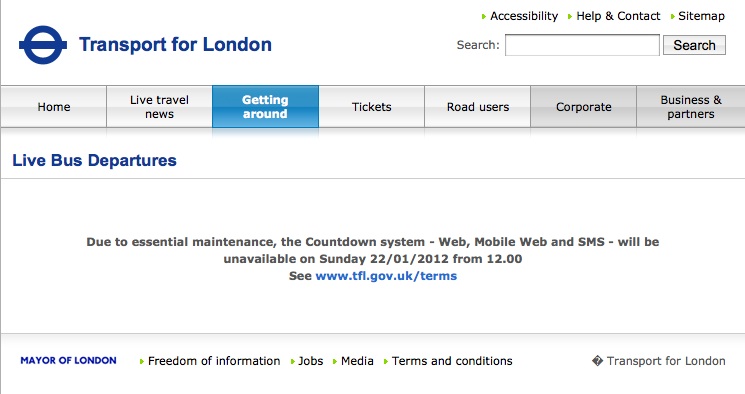
This is the front end to TfL’s “Countdown” system. It tells you which buses are due at a given bus stop and an approximate time that they arrive. The countdown database is updated using location equipment on the buses, and drives LED displays at bus stops, and is accessible over the Internet, including a user interface designed for mobiles, and via SMS short code.

It’s especially useful when services on a route are infrequent, such as on a Sunday, where you may be looking at waiting up to 20 minutes for a bus if you managed to just miss the previous one. So, look back at the screen grab above, note the start time for the maintenance window.

Why do TfL think it’s a great idea to take the system down right at the time on a Sunday that people are heading out to visit family, maybe go out for Sunday lunch, or head to sporting events?

Wouldn’t a better time be the middle of the night on a Monday, when things are much quieter, with fewer users?

Paying techs extra to do system maintenance on a Sunday can’t be cheap either?

What is it with the Virgin Brand?

Or “Why it’s easy to pick fault with Virgin Group companies“.

You may have noticed that I’ve recently been airing my opinion – or is it pent-up frustration – on the service that Virgin Trains provides on the UK’s West Coast Mainline out of Euston station in London. I long ago gave up trying to interact with their customer relations department about their failure to deliver either a promised element of their product, or sometimes what should be just their basic service – a comfortable journey from A to B.

It got me thinking about the wider point of why people seem easily dissatisfied with a service, and specifically Virgin Group as a whole, trains, planes, phones, tv, internet access, etc. A couple of quick searches, especially on social media, and it’s easy to find people going full tilt hating on Virgin Trains, dishing out brickbats to Virgin Media about busted broadband, or flying off the handle about the run-down (thankfully soon to be updated) Gatwick fleet on Virgin Atlantic.

The crux I’ve arrived at is that the Virgin brand tends to overpromise through it’s marketing and brand image and therefore sets itself up to underdeliver and disappoint.

Let’s look at the key connotations of the Virgin brand: Continue reading “What is it with the Virgin Brand?”

Now for the real “Up In The Air”

If you happened to be bored on a plane sometime in 2010, there’s a high likelihood you’ll have seen the film Up In The Air, and some of you may even relate to it. I remember that United Airlines even had the film doctored to remove much of the obvious product placement for competitor American Airlines from the film!

Air New Zealand 747-400, ZK-SUI by robertjamesstarling, on Flickr
Now, there's a nice plane. Still prefer it to the 777.

At the time, I was doing between 75k and 100k miles in flight each year, and while I wasn’t living the somewhat empty, itinerant existance of George Clooney’s character, I was almost certainly doing more travelling than most so-called “Traveller families” were travelling in the UK.

It meant that I could certainly relate to the film, the lead character’s pursuit of miles and elite status, and the benefits of choosing the correct airport security lane. I expect a lot of people reading this post (“Hi, Internet meeting circuit!”) can also relate to this.

I still never got down to living entirely out of a single roll-aboard case for more than a few days at a time though.

An independent film maker, Gabriel Leigh, has decided to make a feature-length documentary about the real frequent flyers, the people who really are “Up In The Air”, all the time, and often for no apparent reason. The film maker is appealing for backing on Kickstarter to raise the money to make the project.

Of course, the real irony would be if he can manage to fly to all the places he needs to when making the film using redeemed miles, rather than paying for a ticket!

Here’s a 20 minute taster of when he initially explored the phenomenon of the FlyerTalker and mileage runner.

One thing which really struck me about this short video was the chap in Tokyo, when he compared the airport to a city and a city to the airport. Everyone just going about their business, speaking their own language, doing their own stuff, in their own world, rarely interacting?

While it’s a true comparison for the mega-airports like Schiphol, DFW, Frankfurt and Heathrow, do we want our cities, our homes, our environments in which we live every day to become as impersonal as an airport? I don’t doubt for a moment that it is happening, but can’t help feeling I think that would be a sad state of affairs in the evolution of the city in the long term.

Bit windy out! Using social media for good…

Unless you’ve been living below ground for the last 24 hours, those of you in the UK can’t have helped notice it’s a bit windy out.

This sort of severe weather inevitably brings disruption, but I’ve been heartened to see a number of organisations using social media to spread the word quickly.

The social media folks @VirginTrains, Amy & Ste, have been doing a great job of relaying information out via Twitter, especially regarding heavily disrupted services into Scotland. Behind the scenes Virgin has been leading the UK rail industry on a project to improve the flow of information to passengers during disruption, and from what I’ve seen today, it seems to be working really well.

They are clearly providing a bi-directional conduit for information – they are getting their info from regular incident update calls (which should happen every 20 minutes, apparently), and direct from their route control, which means the information is very fresh, rather than out of date, which has classically been the normal complaint if you were to phone National Rail Enquiries.

What is missing is a copy of the Twitter feed on the Virgin Trains website – there’s currently no realtime information about the state of their service today provided on their website, no banner saying, “It is windy. Stuff is broken. Please check before you travel.” It is relatively trivial to embed an “alert bar” and/or a Twitter feed into a webpage, and would help those who happen to not use Twitter.

Also worthy mentions to @HeathrowAirport and @LondonCityAir(port) who have been using The Force for good today, providing regular updates about issues with travel to LHR due to a fallen tree on the Piccadilly Line, and to LCY due to an earlier meltdown on the DLR and the high winds making landing and taking off a challenge for the pilots on the smaller planes which fly to London City.

The main thing I think the LCY Twitter folks could do better right now is actually give more info about what is/isn’t cancelled – rather than “contact your airline” which sort of smacks of “not our problem”, even if that’s not the sentiment.

Ah well, wind has picked up again and the sideways rain has returned. I’ll see if I can spy an ark coming down the street.

Rail Re-franchising: Be careful what you wish for!

Following in the wake of the moan about Virgin Trains, a good item regarding the re-franchising of rail services was broadcast in today’s BBC Radio 4 consumer affairs programme, “You and Yours”.

Here’s a BBC iPlayer link to the article – may not work outside the UK, and will expire in the fullness of time.

Tony Miles, a contributor to the rail industry magazine, Modern Railways, explained that the Government will be re-letting a number of UK passenger railway franchises in the coming years, and that a number of European state-owned railway companies are not only showing interest in UK rail franchises, but are already proving successful in winning them, such as the impending takeover of services out of Liverpool Street by Abellio, the International commercial arm of the Dutch railway company, NS, who already operate services in the North of England under a JV with Serco (Northern Rail and Merseyrail).

The Europeans are interested in grabbing a slice of the British pie for two main reasons, firstly because there is some money to be made, and secondly because the privatisation, franchising or deregulation of their home markets is proceeding at a slow pace.

Continue reading “Rail Re-franchising: Be careful what you wish for!”