How two trams having a slow-speed “fender bender” wrecked your day…

…or at least made your morning commute difficult.

If you were trying to travel into work in Manchester this morning, you might have fallen foul of the Metrolink tram system pretty much grinding to a halt for around 30 minutes, right in the middle of the rush hour.

The cause? Two trams having a slow-speed collision at the St Peter’s Square stop.

As can be seen from the photo above, the fairings which protect the coupler (used to attach trams together to make double units) came into contact, and it looks like there might have been some bowing or warping of some of the other fairings.

Unlike when we, as road-users, have a fender-bender in a car, sadly we can’t just shunt off to the side of the road and exchange details, check nothing’s fallen off and proceed on our merry way. There’s a set procedure that has to be followed.

There was a lot of frustration directed at TfGM and Metrolink for how long it took them to respond to the incident.

Before I go on, I should probably explain that I am in a position to offer informed comment on incidents such as this.

Academically I hold a BSc in Transport Management, around 25 years ago I worked for British Rail, and in terms of current railway operations, I am a volunteer “Responsible Officer” – the Duty Operations Manager – for a heritage railway, which is governed by same basic operating rules as the National Rail network and Metrolink.

As a “Responsible Officer” it’s my job to manage problems, issues and incidents, along with subsequent recovery of the service. It’s the same sort of job that the Metrolink Control Room team perform, we use similar principles and work to similar rules, albeit they do it on a somewhat larger and more complex scale.

Back to the incident today, if there is any damage to either tram (however slight), or any significant injuries, this has to be reported immediately to the RAIB (Rail Accident Investigation Branch) by telephone. It’s known as a “Schedule 1” incident. RAIB may want to send their own representatives.

The duties of the operator in a Schedule 1 incident such as this is to not move the involved vehicles at all, until permission is given by the RAIB, and also perform actions themselves to collect and preserve any evidence. The usual response is to assign an Incident Officer to attend the scene and co-ordinate the preservation and collection of evidence. The Incident Officer is a representative of the person in overall charge of the network at the time of the incident.

Even if there was no significant damage, this is known as a “Schedule 3” incident and still requires collection of evidence, and reporting after the fact.

So we know now that we can’t move those two incident trams for some time, and the line through St Peter’s Square toward Piccadilly Gardens and Market St is blocked.

That immediately affects the following tram routes, all booked through the collision platform:

  • Altrincham – Bury
  • Altrincham – Ethiad
  • MediaCity – Piccadilly
  • Eccles – Ashton

Each of the above run on a 12 minute headway. If we assume that is evenly spread, there is a tram coming every 3 minutes from the direction of Deansgate/Castlefield to use that line.

We also need to consider the approaching trams that run via the Second City Crossing (2CC) – the track heading into the city centre splits at a junction just outside Manchester Central and runs up the side of the Midland Hotel as two separate lines toward St Peter’s Sq. These are normally the services from the East Didsbury line to Shaw or Rochdale, these run every 6 minutes.

So adding these in, there is a tram roughly every 2 minutes coming from Deansgate toward St Peter’s Square.

It is very easy to end up in a situation where trams become quickly backlogged around the incident site if action isn’t taken.

As it was, there were three trams – two single and one double tram – behind the incident trams that had become “trapped”, queueing up the side of the Midland Hotel and short of the platform at St Peter’s Square. I can only assume that Metrolink ended up evacuating the passengers from those trams to street level via the emergency ladders – the tram floors are a long way up from the ground!

So, we understand it’s necessary to stop the trams to prevent a gridlock of yellow developing and ending up in a situation where passengers are having to be evacuated down ladders.

The question that must be in most people’s heads is why the entire system remained stalled for as long as it was, and at such a crucial time of the morning commute?

  • Why couldn’t the trams be diverted via 2CC?
  • Why couldn’t the trams be turned around short of the destination?
  • Why couldn’t the trams just run to a different destination?
  • Why was the Bury-Piccadilly service, which doesn’t go anywhere near the incident, stopped?

The fact is, like most rail systems, there are some constraints on the operation that affect the incident response.

Even understanding these constraints, and knowing the challenges the Metrolink Ops staff must have been facing, having dealt with incidents myself, I still felt some disappointment that it took so long to start any form of service recovery.

What I plan on doing is writing a short series of posts discussing these constraints over the next week or so. Some of them are quite peculiar to Metrolink, but maybe it will allow you to make your own mind up about how quickly things can be sorted.

How did we do? Tell us, tell us, puhleeeze…

…or “The rise of the post-purchase survey”

It seems you can’t buy a product or service anymore without receiving a survey about some aspect of it.

I’ve recently done a fair amount of travel, and my email or SMS inbox has been cluttered with pleading survey invites from:

  • Holiday Inn
  • Mercure
  • Sofitel
  • Premier Inn
  • Eurostar
  • Virgin Trains

Usually within 24 hours of you having consumed the service, you get a mithering “Please tell us what you thought” email, which links to a survey.

These organisations must think we have all the time in the world to respond to a load of tedious questioning which, at the end of the day doesn’t capture our personal journey with them at all, despite what they promise.


They can’t read all the survey responses. The data is just rolled up into spreadsheets and charts that help them make (or miss) their “key performance indicators”.

Usually, each survey normally takes around 10 to 15 minutes to complete. That’s 90 minutes of my time that these companies are asking me to give them, for the privilege of buying a service from them.

Yes, I know I don’t have to fill them in, and I’ve largely stopped completing them.

With credit to Holiday Inn, Mercure and Sofitel, they all have a link to “unsubscribe” from receiving future survey invitations. Though I’ll have to see if these actually work. I remain sceptical.

However, this isn’t the case with the last three.

Premier Inn are one of the worst. They send email survey requests with no unsubscribe link. The surveys are long, too. Often 15-30 minutes.

Virgin Trains are slightly better, at least they usually only ask you one question, but I still don’t recall there ever being a way to unsubscribe from their surveys.

Eurostar was just downright baffling. On the way back from Paris, the moment my train left the Channel Tunnel I get this:file-10-02-2017-11-54-44

Followed by these questions, coming from a completely different number:

The first question, I’d have actually liked to score a “N/A” on, as I didn’t actually interact with any Eurostar staff Gare du Nord at all. There were a lot of them standing around with radios looking like they might be important, and occasionally “hustling” late arrivers through to their train, but that was it.

I already had my ticket. I just scanned it on the turnstile and went through the various border and immigration formalities. They did an okay job of marshalling the queues. One of them sort of stood in my way with his back to me at one point, but I didn’t otherwise talk to them nor really have any need to. That’s why I gave it a 5. Neither impressed nor unimpressed.

The second question is more baffling. They have sent me the question about whether I would recommend Eurostar before my journey is complete. I can’t actually answer it yet, because for all I know the train could yet be delayed, or even explode in an enormous fireball, though I think I’d probably only give them a 1 if the fireball happened.

The third question just confirms my suspicions that no-one really reads this stuff. It’s all just parcelled up into a dull spreadsheet. They must send thousands of these a day, and must at least get a few hundred responses.

They are asking this stuff “because they can”, not because they actually care about our individual experiences. These surveys are just providing a barometer of whether there is an upward or downward trend, whether things are meeting an arbitrary target or not, and at their most cynical, providing a means for fat-cat managers to receive bonuses.

The best way to judge how your business is running is to get out on the shop floor. Actually talk to your customers. Listen to your staff. They are your bell-weather.

Also encourage your customers to give direct feedback, then and there. Hilton have recently done this with a “Make it right” policy which lets customers know that they should make their feelings known then and there to the hotel in question, and give them a chance to deal with any shortcomings in service. It also empowers the hotel operators to take corrective action on the spot.

Compare that to a situation at Premier Inn a few years ago where the disenfranchised and under empowered staff member was “Meh, here’s your money back. Take it up with management if you like. Here’s the URL of the complaints form.”

Finally, what’s more annoying to me with these sorts of surveys is that at the point of purchase, while there is usually a means to opt-out of marketing email, there isn’t a means to opt-out of this sort of mithering, because it isn’t considered “marketing”.

So, here’s what I plan to do, should I respond to these:

Write something totally outrageous in the free form text boxes, along with an invite to contact me if someone has actually read what’s been written. That will at least I might get a feel for how many of these are seen by humans!

Post-script: While I was writing this, I got another survey mither from where I ate on Wednesday night, this time from OpenTable on behalf of @HawksmoorMCR. I’m really surprised by that because it’s so orthogonal to their non-corporate house-style when you go and eat there.


#didsburydoubles – How many trams do Metrolink need each day?

Just a quick post this evening.

Did you know that the main Monday to Friday service pattern running today, and the service pattern we had back in June, when we had through trams with a single-line operation through the St Peter’s Square worksite, with double trams on the Didsbury line, actually requires the same number of trams to be in service?

That’s 86 trams.

Out of a fleet of 119. That’s 73% availability. Hardly amazing by today’s standards.

Compare that to Alstom’s Pendolino fleet working Virgin Trains West Coast services. That currently requires 50 of the 56 sets to be available for traffic. That’s an amazing 89% availability for that fleet, which is now over 10 years old.

I guess what I’m saying is that for Metrolink to double the Didsbury – Shaw trams, it would require an extra 12 trams each day, which they do seem to have, and it would still only need 82% availability from the fleet – less than Virgin’s Pendolinos.

These are modern trams, some of which are brand new from the production line, and still being delivered, there will soon be a fleet of 120. They should not be maintenance intensive. Indeed a Manchester Evening News article a few years ago said that the current fleet has an average of 20000 miles between breakdowns, known in the industry as MPC – “Miles Per Casualty”(this doesn’t mean the tram runs someone over, the “Casualty” in this case is the tram itself!). That compares with only 5000 MPC for our old trams.

I surmise that the actual mileage being accumulated under the new timetables is less, because previously there were double trams out all day on Bury – Didsbury, Altrincham – Etihad, and Piccadilly – Eccles lines. Now there are only doubles out on Bury – Altrincham, but only during the main part of the day, and not first thing in the morning or later in the evening.

So it seems there is not a lack of resources preventing double trams being provided where there is clear demand. There is something else going on here. Quite what, I’ll leave up to the reader.

#didsburydoubles – PM Peak 5/9, AM Peak 6/9

A quick round-up of the continuing Didsbury double tram mither.

Here’s one from yesterday morning:

Metrolink did at least respond with an apology, but no real offer to do anything about it.

5/9 PM Commute:

Yesterday evening was very sultry in Manchester. Quite humid and sticky. I can only imagine how awful it must have been. One of those days when I was glad to be working from home.

Meanwhile, Metrolink continue to spin the 6 minute headway to Deansgate as an improvement:

Looks a bit hot and sticky on there, doesn’t it?

6/9 AM Commute:

Slightly less public moaning this morning, maybe people are getting used to their lot of packed sweaty trams, and Metrolink continuing to hold their ground, or they have given up and gone back to commuting on the bus?

Right to Reply:

Yesterday evening, Councillor Andrew Simcock, who I yesterday said seemed to be behaving as a TfGM apologist, chose to leave a comment on the post.

I’d like to go on record to thank the Councillor for using this right of reply to clarify his position.

While he reiterated his point of view that the 6 minute service was an improvement, it still seems terribly out of step with what I’m seeing social media, and out on the streets of Didsbury.

The Councillor also stated that he hoped with continuing TfGM investment in Metrolink, double trams may once again be provided in line with demand in the future, so this is positive.

Nevertheless, the Councillor has invited unhappy East Didsbury constituents to raise the issue with him at his regular surgery, which happens this Saturday morning , 11.30, at Didsbury Library.

If you are at all dissatisfied with the situation and Councillor Simcock is one of your representatives on the Council, please take the time to attend and make your voice heard.

I live in the Chorlton Park constituency, and have already raised the issue with my local representatives.

#didsburydoubles – the current state of play

So, the weekend has passed and the kids are back to school. I’m working from home today so haven’t experienced the Metrolink this morning.

Travelling in last Friday…

Following that tweet, I was told by Metrolink social media that they can’t discuss the matter over social media and I should put my complaint regarding the withdrawal of double trams in writing to TfGM’s “customer services”.

Over 24 hours later, while I have received an auto-reply acknowledging receipt, I’ve yet to get a case number or any other correspondance from TfGM.

Over the weekend I noticed that the advertised Double tram service Bury – Altrincham was running as single trams. I contacted Metrolink about that too. They say that Bury – Altrincham directs are now reduced to single trams at weekends and their own timetable is wrong!

What on earth is going on at TfGM and Metrolink towers?

I do wonder if the running of lots and lots of double trams (Bury-Dids, Alty-Etihad, Eccles line) during the period of “contraflow” on Mosely Street while St Peter’s Square was closed has actually caused the fleet to accumulate mileage quicker than anticipated, and the operation of single trams now is what is known in the industry as mileage conservation – stretching the period of time between planned examination and servicing by those affected trams running fewer miles.

This is also common in the aviation industry, where aircraft undergo checks based on hours flown – an aircraft approaching a major maintenance check can be put on restricted use, so it’s only used if absolutely necessary, until it’s place in the hangar is assured.

Back to the main subject, the loss of the much needed double trams from the Didsbury line, it seems people are still experiencing unpleasant journeys on overcrowded trams.

Here’s a quick scan of social media from this morning:

It’s also not just the Didsbury line. Eccles line users are grumpy too. Both about the basic quality of the service, and the fact that Eccles line trams don’t serve MediaCity UK for the majority of the day, which seems like a total chocolate teapot.

One can only imagine the answer to the question below:

What seems to be getting people’s hackles up further is the way we’re being talked down to by TfGM and Metrolink. The tone of the replies is like a parent trying to placate a child having a tantrum, rather than accept and acknowledge there has been a service delivery failure and that something positive will be done:

I don’t blame the people running the social media accounts at TfGM and Metrolink. I accept their hands are somewhat tied by the decisions of their bosses. But they need to stop talking down to us. We need to see there is some action being taken, rather than head-in-sand apologism.

However this particular exchange seems at least churlish, and possibly out-of-order, especially for a public servant talking to a member of the public they are meant to be working on behalf of. Maybe it’s a chink in the armour, showing that tempers are even getting frayed at Metrolink HQ, behind the calm veneer of the “Shush, shush… Everything’s okay, it will be all fine once 2CC opens” party-line:

What seems to be worse still is that at least one Didsbury councillor is acting as a TfGM apologist rather than representing their constituents:

Evidently, according to Andrew, we should just shut up and be grateful that we even have a tram:

This goes on to the extent that he’s openly disagreeing with other Manchester City Councillors from neighbouring wards who agree with residents that the new single tram service is a retrograde step:

Why would you change at Cornbrook and St Werburghs if you had the choice of a direct tram? The above feels like a load of old tosh. Also note that Andrew’s tweets there were sent from outside of Manchester, so it seems that he can’t have experienced this new single tram overcrowded fiasco for himself recently if he’s been out of town.

I’m honestly glad I’m not in the East Didsbury ward if that’s the standard of representation I can expect.

So what next?

Metrolink wish we would put up and shut up.

TfGM wish we would put up and shut up.

Now, one of our elected representatives also seems to wish we would put up and shut up – rather than doing what he’s been elected to do!

Remind me that we’re meant to be living in a democracy? Remind me that public servants are meant to be accountable?

A former BBC journalist friend said “Don’t give up. Keep kicking off. Make as much noise as you can until they open a proper two-way dialogue with you.”

We need to make as much noise as we possibly can until we are listened to on this issue:

  • Please tweet about your overcrowding experiences, and use the hashtag #didsburydoubles, so the trend is visible.
  • Tweet Metrolink every time you experience an overcrowded Didsbury line tram.
  • Please retweet what others say as well so we’re reaching as many people as possible.
  • Write to TfGM – customer.relations@tfgm.com – request that a formal complaint is opened.
  • Write to your Councillors – use www.writetothem.com

#didsburydoubles – What might it take to put doubles back on the Didsbury line?

I’m a transport geek. I find stuff like timetables absolutely irresistible.

So thanks to the working timetables exposed in the FOIA request I took a look over lunch to find out what extra resources would be required to provide double trams once again on the Didsbury line.

Firstly, the notionally “busier” Cross-City services – the Didsbury-Shaw trams.

The Didsbury-Shaw 12 minute frequency service requires 12 trams on a circuit to operate it – i.e. it takes 144 minutes for one tram to complete a full round-trip.

There are two Metrolink depots, the original one at Queens Road, and the newer and larger depot at Trafford.

The duties for the Didsbury-Shaw service are split between the depots, 5 duties are provided by Queens Road, and 7 by Trafford.

So, to increase all the Didsbury-Shaw trams, that would require all 12 duties to be double trams, an extra 5 trams provided by Queens Road, and 7 from Trafford.

I don’t know what sort of spare resources Metrolink has around. I can usually see more than 8 trams sat stabled at Trafford depot when I go past in the morning – though I accept they could be stopped due to a fault or awaiting scheduled maintenance such as a planned servicing.

Secondly, the Didsbury-Deansgate service.

This is a much simpler operation, composed of 4 single-tram duties from Trafford depot, on a self-contained “shuttle” operation between Didsbury and Deansgate.

It is therefore theoretically simpler to double, requiring an additional 4 trams to be supplied from Trafford.

To provide double trams on both the Didsbury-Shaw and Didsbury-Deansgate services would require 16 extra trams to be available for traffic.

We’ll assume providing all 16 trams is a non-starter, that Metrolink simply don’t have 16 spare trams available on a daily basis for the moment.

There are three options, as I see them, assuming no significant service changes:

  • The least resource intensive is for Trafford to provide an extra 4 trams each day and convert the 4 Didsbury-Deansgate shuttle duties to double trams.
  • The other is to double all the Didsbury-Shaw duties, which requires 12 extra trams, a somewhat tougher ask.
  • The slightly more radical option is to cancel the Didsbury-Deansgate shuttle, and revert to a 12 minute headway. Use those 4 released trams to strengthen 4 of the Trafford Dids-Shaw duties, only requiring a further 8 trams to be provided, 4 from each depot.

Right now, it seems that the path of least resistance and possibly most rapid solution is for Didsbury-Deansgate trams to be doubled. It feels less than ideal, as the notionally busier trams are the Cross-City ones. But this might at least encourage some passengers to choose to change at Deansgate rather than wait for the direct tram and alleviate some pressure on the Didsbury-Shaw.

However, I feel all doubles on a 12 minute headway used to work okay before. Do we want to go back to that?

#didsburydoubles update – Metrolink Working Timetable via FOIA request

Thanks to Twitter follower @ppixx I’ve been pointed in the direction of a FOIA request which resulted in the release of the Working Timetables currently in use (as of 28th August 2016) on Metrolink.

https://www.whatdotheyknow.com/request/manchester_metrolink_working_tim_5#incoming-849104

The “Working Timetable” is the hidden “technical” timetable that Metrolink staff use to manage and maintain the service. As such it contains movements of empty trams, like workings to and from depots at the start and end of service. It’s not written to be read by mere mortals.

In terms of what’s happened with our Cross-city Didsbury line commutes, the useful information here is the sequence of trams through the network. This is the bit of information I told you in my last post we didn’t readily have, yet need, to help us make decisions whether to wait for the direct tram or take the first tram and change.

I’ve done the hard work so you don’t have to: What it shows is that if you are travelling to a point beyond Deansgate from the East Didsbury line, during the 6 minute headway period, you may as well almost always wait for the direct tram.

By taking the Deansgate tram and changing, you will have a 4 minute wait for the Altrincham – Bury tram to continue toward Market St, Shudehill and Victoria.

By leaving 6 minutes earlier – because we’re assuming for this example that the first tram is the Deansgate tram – and changing, this is reduced to a 2 minute advantage by the time you get off. The direct tram has almost “caught up”.

However if you are travelling to St Peter’s Square, Piccadilly Gardens or Piccadilly, it makes no significant difference which tram you take from the Didsbury line, both the Deansgate and the Shaw trams have good connections into Piccadilly-bound trams at Deansgate. Both are good options.

#didsburydoubles – can we get Metrolink to reinstate double trams to East Didsbury?

The summer is over, and it’s time to get back to work.

For many of us in Manchester, we breathe a sigh of relief as it also signals the reconnection of the Northern and Southern parts of the Metrolink tram network after almost two months of no service through the City Centre.

Our messed up commutes could return to something looking like normality, or so we thought…

Last week, Metrolink announced their new service patterns for the re-joined network, no longer constrained by the single-track contraflow system through the St Peter’s Square worksite:

“People of Didsbury rejoice! For we are improving your service, with trams every 6 minutes!”

Now here’s the catch and small print:

Note that while there are twice as many trams, 
they will only be half as long, 
and half of them will terminate at Deansgate, 
on the extreme south side of the city centre, 
which will mean they are no use to some of you.

So, while we get more frequent trams, at least as far as Deansgate, the overall capacity on the line has stayed the same, yet we were experiencing busy and crowded trams when they were double trams every 12 minutes, and we’ve now actually got reduced capacity on cross-city journeys.

We’re already seeing complaints about crowding and reduction of tram length:

So I’ve decided to start tweeting and hashtagging when I observe overcrowding due to single tram operation on the Didsbury line, using the hashtag #didsburydoubles and suggest those similarly affected do the same.

We then make it easier to track and hopefully get this trending on social media and get Metrolink & TfGM to sit up, listen to their users and understand how we actually use their tram network.

On paper the capacity is the same, so what’s happened?

Metrolink planners have made an assumption that passengers will always take the first tram and change where necessary.

Taking a look at my more usual trip into town, I’m normally heading to Market Street or Shudehill:

  • Under the old service pattern there was a direct double tram every 12 minutes.
  • Under the new service pattern there is a direct single tram every 12 minutes, or I can take the Deansgate tram, which runs in between the direct tram, and change at Deansgate.

I now have to make a decision, do I take whatever turns up first and proceed accordingly, or do I always wait for the direct?

I’m missing a vital piece of information if I take the Deansgate tram and change: How long will I need to wait at Deansgate for a Market Street/Shudehill tram?

What I don’t have is the planned sequence through Deansgate. I know that each “route” is planned to have a tram every 6 minutes, and it repeats on a 12 minute cycle. I just don’t know the order they are meant to come in, because Metrolink does not publish that information.

If the tram terminating at Deansgate is immediately followed by a cross-city Altrincham – Bury tram, then I’m fine. My end-to-end journey time remains basically the same, I have to change once, and don’t have to wait long.

But what if the sequence of trams means that I’m waiting, let’s say 4 minutes, for the Altrincham – Bury direct tram? Or worse still, my Didsbury – Deansgate tram arrives at Deansgate platform just in time to see the Altrincham – Bury tram pulling away?

I don’t gain anything and I may as well have taken the direct tram, and who’s to say I’ll be able to even get on to the next tram, that might be busy too?

They have not accounted for human nature: where a direct service exists we will prefer to take it.

Remember that I am a transport geek as well. I’ve studied this stuff, and have a degree from Aston Uni in Transport Management. The thought process above comes naturally to me. Heh… Maybe TfGM/Metrolink could hire me to tell them the blindingly obvious?

An average person won’t even bother going though the thought process above. They will just wait for the direct tram.

On outbound journeys in the evening commute, this situation is made even worse. People are less inclined to change on the way home, because the trams are already at their fullest in the City centre.

One simply daren’t take the first cross-city tram from Shudehill or Market Street and expect to change at Deansgate or Cornbrook because that will mean trying to board an already crowded tram.

This means evening commutes will likely be worse than morning commutes because people will almost certainly wait for the direct.

When the Didsbury line was first opened, there were waves of complaints because the use of the line outstripped Metrolink’s predictions, rapidly leading to the decision to run Didsbury trams as doubles, and this remained until this week.

It’s time to make sure TfGM and Metrolink hear our voices again.

We should at least have the through trams operating as double trams, so that cross-city capacity is restored to what it was before the St Peter’s Square works were completed.

This is how the Altrincham and Bury lines work – a 6 minute headway with alternate trams, the cross-city trams, as doubles.

If you experience an uncomfortably crowded journey on the East Didsbury line, or you have to let a tram depart without you onboard because it arrived already full, please tweet about it and use the #didsburydoubles hashtag.

Tech Skills: Business Needs to Give Back to Education?

Another day, another skills and tech education rant…

My thoughts here are partly triggered by this tweet about the HE system being effectively broken, from Martin Bryant of Tech North:

The overall takeaway is that the current HE models aren’t working for the tech sector on two counts: a) It moves too fast and b) There is too much to learn. Sounds like a perfect storm. The syllabuses and the people doing the teaching are continually at risk of being out of date.

I agree with the comments in the article that there is an expectation mismatch going on.

Companies can’t realistically expect graduates to just drop into a position and be as useful and productive as a person with several years’ experience, nor can they expect them to know the ins and outs of every protocol or language. As an employer, there needs to be some sort of development plan in place for every person you hire.

I’ve previously written about my own entry into the tech industry, somewhat by accident, in the 1990s: that I left University with a degree in nothing to do with tech, but with a solid understanding of the fundamentals, and basically ended up learning through apprenticeship-type techniques once on the job in an ISP.

Where I believe tech companies can help is by pouring their real-world knowledge and experience back into the teaching, and by this I mean moving beyond just the usual collaboration between industry and education and taking it a stage further: Encouraging their staff to go into Universities and teach, and the Universities to do more to guide and nurture this.

Yes, it takes effort. Yes, for the tech firms releasing staff members one or two days a week to teach, it’s going to be a longer term investment, the payback won’t immediately come for three to five years. But once it does arrive, it seems that the gift will keep giving.

For the Universities, they will need to support people who maybe aren’t experienced in teaching and find new ways of making their curriculum flexible enough to keep up.

I see this potentially having multiple positive paybacks:

  • For the University: they are getting some of the most up-to-date and practical real-world knowledge being taught to their students.
  • For the Students: increased employability as a result of relevant teaching.
  • For the Industry: a reducing skills gap and more inquisitive and employable individuals looking for careers.
  • For the tech employee doing the teaching: a massively rewarding experience that can help increase job satisfaction.

For this, I’d like to put my industry colleague Kevin Epperson on a bit of a pedestal. Kevin is an experienced Internet Engineering professional, and has worked at big industry names such as Microsoft, Level 3 and Netflix, in senior Network Engineering leadership roles. Kevin also teaches at University of Colorado, Boulder and is the instructor of their IP Routing Protocols course.

This is something Kevin has been doing for 15 years, during tenures at three different employers, and recently received an award for his contributions to their ITP courses.

The value of having a real-world industry expert involved in instructing students can’t be underestimated, yet I can think of very few people in my part of the tech industry – Internet Engineering – that actually teach in the formalised way Kevin does. All I can really think of is people doing more informal tutoring at conferences, and helping to organise hackathons and other events, which don’t necessarily reach the HE audience we’re discussing in this article.

The industry needs to be willing to move outside the rigid “full-time” staff model that I still find many companies wedded to, despite claims to the contrary, and be confident about releasing their staff to do these things, in order to give back. It may even improve staff retention and satisfaction for them, as well as produce more productive new hires! Be interested to see if people have real stats, or just good stories, on that.

Yet, at the same time, we’re talking about an industry that won’t give many members of staff a day out of the office to attend a free industry event which will benefit their skills and experience and improve their job satisfaction. Why? Who knows? I have hard data on this from running UKNOF that I’m willing to share if folks are interested.

The answer that I don’t have is how receptive the Universities would be to this? Or do they have their own journey of trust to go on?

Net Eng Skills Gap Redux: Entry Routes into Network Engineering

While I was recently at the LINX meeting in London, I ended up having a side-discussion about entry routes into the Internet Engineering industry, and the relatively small amount of new blood coming into the industry.

With my UKNOF Director’s hat on for a moment, we’re concerned about the lack of new faces showing up to our meetings too.

Let me say one thing here and now:

If you work in any sort of digital business, remember that you are nothing without the network, nothing without the infrastructure. This eventually affects you too.

Yes, I know you can just “shove it in the Cloud”, but this has to be built and operated. It has real costs associated with it, and needs real people to keep it healthily developing and running.

I’ve written about this before here, almost 3 years ago. But it seems we’re still not much better off. I think that’s because we’ve not done enough about it.

One twitter correspondent said, “I didn’t know the entry route, so ended up in sysadmin, then internet research, and not netops.”

This pretty much confirmed some of my previous post, that we’d basically destroyed the previous entry route through commoditisation of first-line support, and that was already happening some time around 1998/1999.

It’s too easy to sit here and bleat, blaming “sexy devops” for robbing Net Eng and Network Infrastructure of keen individuals.

But why are things such as devops and more digital and software oriented industries attracting the new entrants?

One comment is that because a large number of network infra companies are well established, there isn’t the same pioneering spirit, nor the same chance to experiment and build, with infrastructure compared to the environment I joined 20 years ago.

My colleague, Paul Thornton, characterised this pioneering spirit in a recent UKNOF presentation titled “None of us knew what we were doing, we made it up as we went along” – note that it is full of jargon and colloquialism, aimed at a specific techie audience, but if you can excuse that, it really captures in a nutshell the mid-90’s Internet engineering environment the likes of he and I grew up in.

Typing “debug all” on a core router can liven up your afternoon no end… But I didn’t really know what I wanted to do back then, I was green and wet behind the ears.

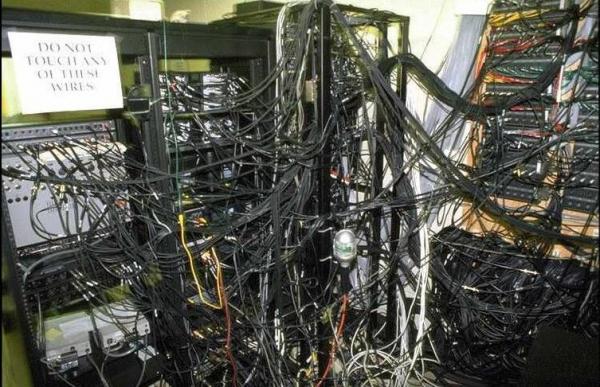
Many infrastructure providers are dominated by obsessions with high-availability, and as a result resistance to change, because they view a stable and available infrastructure as the utopia. An infrastructure which is being changed and experimented upon, by implication, is not as stable.

do-not-touch-any-of-these-wires
DO NOT TOUCH ANY OF THESE WIRES

Has a desire to learn (from mistakes if necessary!) become mutually exclusive from running infrastructure?

In many organisations, the “labs” – the development and staging environments – are pitiful. They often aren’t running the same equipment as that which exists in production, but are cobbled together from various hand-me-down pieces of gear. This means it’s not always possible to compare apples with
apples, or exactly mimic conditions which will exist in production.

Compare this to the software world, where everything is on fairly generic compute, and the software is largely portable from the development and staging environments, especially so in a world of virtualisation and containerisation. There’s more chances to experiment, test, fail, fix and learn in this environment, than there is in an environment where people are discouraged from touching anything for fear of causing an outage.

This means we Network Engineering types need to spend a lot of time on preparation and nerves of steel before making any changes.

Why are the lab environments often found wanting? Classically it’s because of the high capital cost of network gear, which doesn’t directly earn any revenue. It’s harder to get signoff, unless your company has a clear policy about lab infrastructure.

I’m not saying a blanket “change control is bad”, but a hostile don’t touch anything” environment may certainly drive away some of the inquisitive folks who are keen to learn through experimentation.

Coupled with the desire of organisations to achieve high availability with the lowest realistically achievable capital spend, it means that when these organisations hire for Network Engineering posts, they often want seasoned and experienced individuals, sometimes with vendor specific certifications. You know how I hold those in high esteem, or not as the case may be, right?

So what do we need to do?

I can’t take all the credit for this, but it’s partly my own opinions, mixed in with what I’ve aggregated from various discussions.

We need to create clear Network and Infra Engineering apprenticeship and potential career paths.

The “Way In” needs to be clearly signposted, and “what’s in it for you” made obvious.

There needs to be an established and recognised industry standard for the teaching in solid basic network engineering principles, that is distinct from vendor-led accreditations.

In some areas of the sector, the “LAIT” (LINX Accredited Internet Technician) programme is recognised and respected for it’s thoroughness in teaching basic Internet engineering skill, but it’s quite a narrow niche. Is there room to expand the recognition this scheme, and possibly others have?

A learning environment needs to exist where we enable people to make mistakes and learn from them, where failure can be tolerated, and priority placed on teaching and information sharing.

This means changing how we approach running the network. Proper labs. Proper tooling. Proper redundant infrastructure. No hostile “change control” environment.

Possibly running more outreach events that are easier for the curious and inquisitive to get into? That’s a whole post in itself. Stay tuned.