WCML Rolling Stock: 1987/1988 Longsight Mk2 air-con “half-sets”

While reminiscing about the WCML operations with folks on Facebook and elsewhere, it struck me that while a lot of attention was paid to the locomotives, less was given to the train formations – but this was something that I did pay attention to. So, I thought I’d spend a bit of time documenting what I remembered and recorded from the era as I dig through my own memories and archives.

This is likely going to be the first article in a series...

Pre-1990, it was common for some of the Anglo-Scottish Intercity trains on the WCML to split en-route – often at Carstairs, where a portion would be detached to serve Edinburgh, while the remainder went forward to Glasgow. The formations on these workings were known as “half-sets” – in the sense they were about half the length of a more normal train consist, and two put together provided the more usual number of seats for a WCML train.

It was more usual for trains which started at locations other than Euston to split portions, so for me this timetable stands out for having these half-sets which worked to Euston, and the variety of services these sets covered raises an eyebrow!

This subfleet was based at Manchester Longsight and used air-conditioned Mk2def coaches: Brake Second Open (BSO), Tourist Second Open (TSO), and First Corridor (FK).

There were a total of 12 diagrams, MA275-MA286, all formed BSO-3x TSO-FK.

Where provided, catering was rostered for Mk1 RBR vehicles, usually in the middle of a train – sandwiched between the two half-sets – working their own circuits in the MA5xx range.

The Carriage Working Notices and other marshalling data showed that the FKs ought to both be next to the RBR where present. This means that the sets sometimes needed to be turned – usually at Glasgow (where the ECS between Central and Polmadie would include a reversal at Shields Rd), or Edinburgh (which used a triangle in the Abbeyhill area).

Services worked included:

  • Euston – Inverness “Clansman”
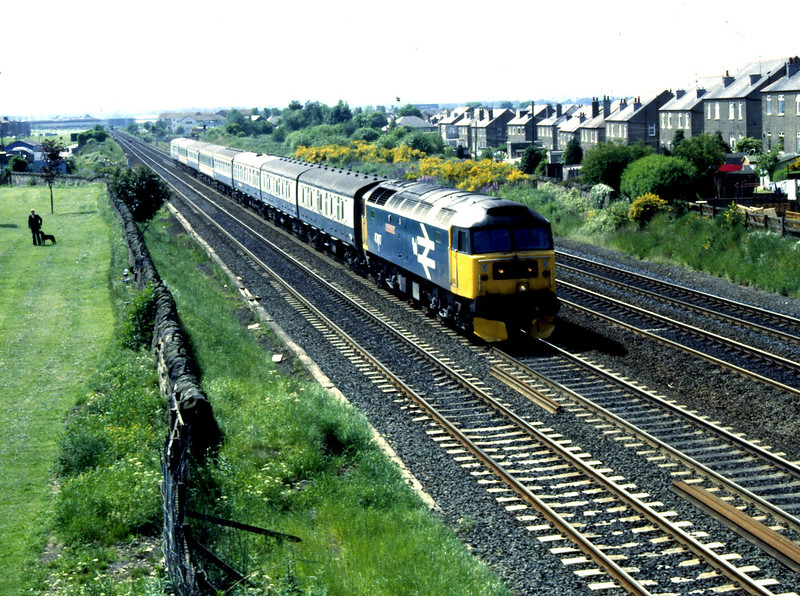
47617_carrickknowe_19870619
1M42 Up “Clansman” nears Edinburgh – the front two NEX full-brakes are on Scottish Internal circuits and come off at Waverley , when the main part of the set is pieced up with the half-set on MA275 which is waiting at Edinburgh having worked North from the West Midlands on 1S53.
The inconsistency of the era is clearly visible, the FK is not air-conditioned, just a Mk2c pressure-vent, as is the BSO at the extreme rear.
  • Euston – Stranraer boat train
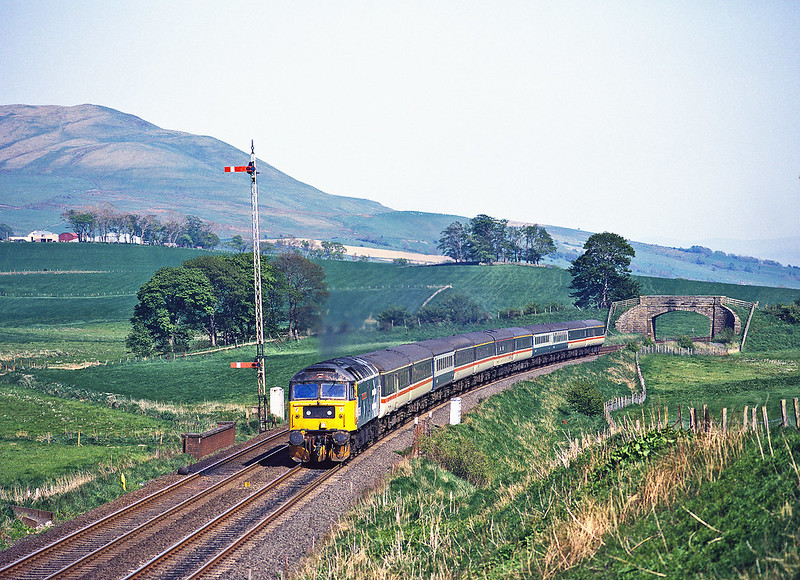
CBI
A pair of Longsight half-sets working MA280/MA285 diagrams behind 47595 on the GSW with 1S74 Euston-Stranraer
  • The morning Birmingham New St – Glasgow/Edinburgh
  • A mid-morning Manchester – Glasgow/Edinburgh
  • The balancing Up workings of the above were much less straightforward!
  • An early morning Wolverhampton – Euston service and an evening return – this stands out as being one of the few “EBW” services not worked by the Oxley-based fleet.
  • Seated portions of the Euston-Stranraer sleeper and Barrow-Euston sleeper!
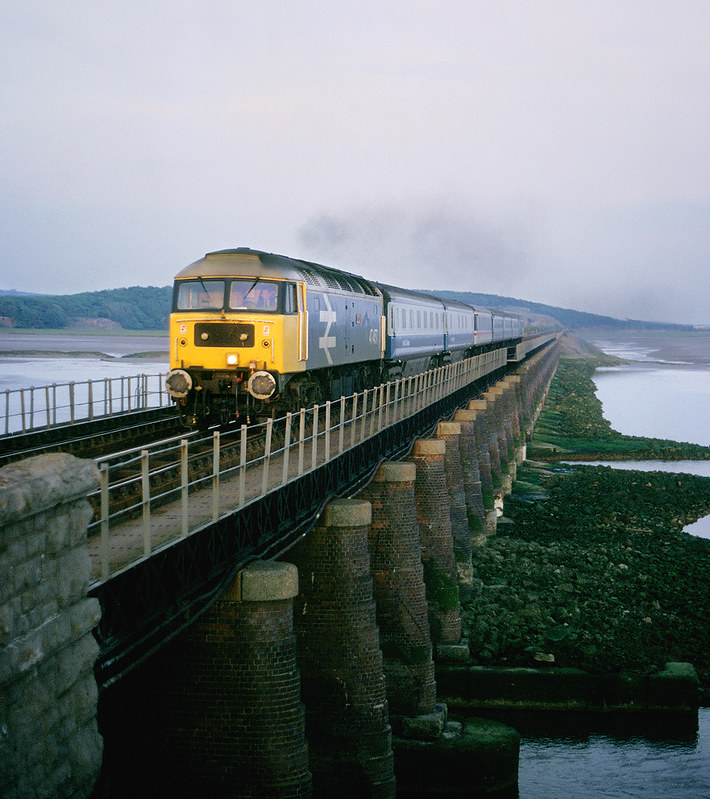
Barrow Sleeper ECS On Leven Viaduct.
The Longsight half-set working MA278 diagram is behind the Mk3 sleepers on 1P10 Preston-Barrow. The sleepers will have worked up from Euston on the front of 1P38 “Lancashire Pullman”.

The amount of variety and how the portions cycled around the work was quite something.

The fleet was used quite intensively, some diagrams were quite complex, with very little in the way of “out and back” work.

Despite calling Longsight their “home” depot, only two half sets a day worked back to Manchester for overnight stabling, Oxley and Wembley seemingly playing a bigger part in overnight stabling and servicing.

The quality of the vehicles could be quite variable as well – some refurbished, some not, and substitutions with “fresh air” Mk2abc stock not uncommon. The substitutions could persist until the set next cycled through Longsight.

This was quite a downgrade from 1986 for both the “Clansman” which benefitted from refurbished Mk3a stock, and 1S53/1M47 “Midland Scot” that saw some of Oxley’s first Mk2f refurbishments deployed captive on OY275/276 diagram.

Using the LMR Carriage Working Book from 1987, I’ve reconstructed the Monday to Friday diagrams:

MA275
ECS Oxley – Birmingham NS
1S53 0725 Birmingham NS – Edinburgh RP (with MA276/MA500)
1M42 1438 Edinburgh – Euston RP (1030 ex-Inverness, with MA282/MA505)
Forms MA279

MA276
ECS Oxley – Birmingham NS
1S53 0725 Birmingham NS – Glasgow C FP (with MA275/MA500)
1M87 1550 Glasgow C – Manchester V FP (with MA501/MA278)
ECS to Longsight
Forms MA278

MA277
ECS Longsight – Manchester V
1S49 1025 Manchester V – Glasgow C FP (with MA501/MA278)
1M47 1750 Glasgow C – Birmingham NS FP (with MA500 throughout/MA283 attaches Carstairs, detaches Preston)
ECS to Oxley
Forms MA284

MA278
ECS Longsight – Manchester V
1S49 1025 Manchester V – Edinburgh RP (with MA501/MA277)
1M87 1544 Edinburgh – Preston RP (with MA501/MA276)
1P10 1940 Preston – Barrow (with WB573)
1K12 2149 Barrow-Stafford (with WB573, detached at Stafford)
ECS to Oxley
Forms MA283

MA279
1M06 1055 Stranraer – Euston RP (with MA502/MA286)
1G47 2110 Euston – Wolverhampton FP (with MA502/MA286)
ECS to Oxley
Forms MA276

MA280
1S74 1000 Euston – Stranraer RP (with MA503/MA285)
Forms MA286

MA281
1S06 2105 Euston – Stranraer FP (with WB554)
Forms MA279

MA282
1M42 1030 Inverness – Euston FP (with MA505, MA275 attached Edinburgh)
Forms MA280

MA283
ECS from Oxley
1A72 0556 Wolverhampton – Euston RP (with MA284/MA504)
1S59 0855 Euston – Edinburgh FP (with MA284/MA504)
1M44 1744 Edinburgh – Manchester V RP (with MA500/MA277 to Preston)
ECS to Longsight
Forms MA277

MA284
ECS from Oxley
1A72 0556 Wolverhampton – Euston FP (with MA283/MA504)
1S59 0855 Euston – Inverness RP (with MA504, MA283 detached Edinburgh)
Forms MA282

MA285
1S74 1000 Euston – Stranraer FP (with MA503/MA280)
1M14 2225 Stranraer – Euston RP (with WB555)
Forms MA281

MA286
1M06 1055 Stranraer – Euston FP (with MA502/MA279)
1G47 2110 Euston – Wolverhampton RP (with MA502/MA279)
Forms MA275

These diagrams and arrangements only existed for 1987/88, and didn’t persist.

The Clansman went over to a Wembley based Mk2f rake in May 1988, the operation again interesting in itself, being another half-set arrangement with a portion for Aberdeen, and “curious” buffet cars for trains out of Euston. Some of the portion working splitting at Carstairs started to be reduced, and most of the non-Euston related work was covered by an enlarged Polmadie fleet and slightly simpler Longsight duties – effectively one of the early hints of things to come with sub-sectorisation.

Planes, Trains, and a couple of bus companies from Scotland…

Well, the Great British Public have rallied around the underdog, as per usual, this in the Great Train Sale. There have been huge outpourings of support for Virgin Trains since the news that they would not be running the services out of Euston from December, and there is even an e-petition to urge the Government to look again at the decision which is gaining a lot of support.

It’s also going to be more than a co-incidence that Virgin Atlantic have announced a move into UK domestic operations the week after the news that the WCML franchise would be going to a competitor. Even though there has been speculation that this was on the cards since BA bought UK competitor BMI, and there must have been planning going on in the background, launching when they did has maximised publicity for the new VAA operation, riding the wave of publicity around Richard Branson saying words to the effect “We probably won’t bid for another rail franchise again, unless things change”. Because it’s diversified, Virgin can afford to “walk away”, or at least appear to, and at the same time deliver a parting blow to both the DfT and the incoming WCML franchisee, First Group.

Of course, being the underdog is nothing new to Branson – think of the “Dirty Tricks” affair with BA – so he knows how to play this role pretty well, and the man in the street finds it easy to get behind Branson as being a “people’s champion” versus the dull, bland corporates.

However, what happens next? Well, unless Virgin decide to back off, accept the franchise loss, and decide to compete in the air, it’s going to cost us (and by “us”, I mean the UK taxpayer) even more money:

If the franchise is debated in Parliament as a result of the petition, it will cost the taxpayer money.

If Virgin decide to appeal the decision, and take it to a judicial review, this will cost the taxpayer money.

If the DfT make a u-turn and decide to take the franchise away from First Group, and award it to Virgin, then First will likely want a review of their own, and/or seek compensation. Who’s going to pay for that? The taxpayer. Not First shareholders, not Stagecoach shareholders (remember, they own 49% of VT), not Richard Branson, who I’m thinking was evidently right when he dismissed rail franchising as “insane”.

The whole crazy privatisation, hashed together by the bungling Major Government, of Britain’s railways has cost the taxpayer billions, and delivered minimal benefit to the passenger.

The normal rules of a deregulated market do not apply on the majority of Britain’s railways. There is often no consumer choice other than “take it or leave it” for the majority of rail journeys, as only one operator provides a service. Many attempts at competition and open access have either failed (such as Wrexham & Shropshire), have been blocked because it threatens the incumbent franchisee, or are simply non-starters because there’s insufficient capacity in the infrastructure.

If a rail operator fails, then services aren’t allowed to stop running, because that would have disastrous consequences, instead the Government step in and constitute a quango to run the service, while the private company skulks off.

A bit like bailing out the banks when they screwed up. It’s already been done with the failure of Railtrack, and with a couple of franchises.

So, instead of competition and choice, we have an expensive raft of lawyers, consultants, and contract managers that has evolved to support our dysfunctional railway franchising and track access ecosystem.

For instance, because of the punitive blame-placing system of managing delays on the modern railway, there are teams of people known as “delay attributors” who trace train delays through the system, and work out how they were initially caused. Not so that the cause is avoided in future, so the delays are reduced, but primarily so that someone is “blamed” for the delay, so a settlement plan can push “pretend money” around between Network Rail and the train operators, because at the end of the day, it all likely balances out over time, and little real money actually changes hands.

This even costs money and time at the coal face. Example: A friend who is a Guard for a national operator was harrassed by their manager as to why their train took an extra two minutes between two points on the railway that their train didn’t even stop at. Of course, they had no idea why, because the train didn’t even stop there, and they were busy checking tickets. It left the previous station on time, and the train was on time the next station. Evidently, there was some pressure from a delay attributer on these two minutes even though they had no consequence for those on board the train. How is this a good use of our money?

Of course, this never really translates to benefit for the passenger (or the freight customer) – the various bodies involved in running the trains just point fingers.

There are a number of bodies, including the Bring Back British Rail campaign, who would like to see the railways renationalised, and they may have a point.

Ironically, during the latter years of BR, some elements of the business – such as Intercity – actually delivered a significant surplus. This in turn reduced the taxpayer burden on subsidising those services which required it – the benefit of an integrated company.

There have been attempts to build franchises which use this theory, such as the single First Great Western franchise – this used to be several seperate franchises, a profitable Intercity franchise, and subsidy-dependant commuter and rural services – the idea being a franchised operator can’t just cream off the profitable stuff, and there’s a resultant overall reduction in public subsidy for the commuter and rural services, being buoyed up by revenue from the longer distance services. However, given that First Group are now exercising the break clause in the Great Western franchise, allegedly as it’s no longer viable to pay the DfT to run the franchise (due to depressed revenues due to falling commuter numbers), even this hasn’t worked out quite as planned.

We’ve also got a laughable situation where it seems that a state-owned UK company cannot theoretically bid for a railway franchise, but at the same time we’ve got the commercial/international arms of mainland European state-owned rail operators who did, and now run UK rail franchises – Arriva (who also own Chiltern) are Deutsche Bahn, Abellio (behind Greater Anglia and Northern franchises) are Nederlandse Spoorwegen, and Keolis (who are part owners of Southern, SouthEastern, and TransPennine) are actually majority owned by SNCF. Does this consititute a net flow of taxpayer subsidy out of the UK?

This was recently highlighted in the Scottish Parliament – where you consider that ScotRail is 75% publically funded through subsidy – then why was this going to a commercial for-profit operator? Why could Holyrood not incorporate a Scottish state-owned non-profit company to run the service? Apparently, there’s some red tape in the 1993 Railways Act to deal with.

So, returning back to the WCML franchise: Branson is certain the First Group bid will result in an East Coast style bail-out. Now he’s competing in the sky, that may even give this a nudge. What if others follow Branson’s lead, dismiss railfranchising as “crazy”, and no-one wants to take on the poison chalice of the ECML?

If we assume for a moment that the new WCML franchise goes bump before the DfT can re-let ECML, does the Government end up running WCML and ECML?

Is that a foundation for re-nationalisation of train operations through the back door?

Virginity Lost. First to gain Intercity West Coast Franchise…

Well, the fat lady has sung. Virgin Trains did not regain the franchise to run West Coast mainline trains out of London Euston up to Birmingham, the North West, and Glasgow. The franchise will be taken over by First Group in December this year.

I have mixed feelings, as Virgin did a lot of good things, particularly to attract business travellers out of their cars and away from domestic air travel, and their excellent use of Social Media, but they also did some pretty iffy things as well, and like so many Virgin companies, place form over function, style over substance.

But, what does this mean to you?

There’s been a lot of claptrap in the twitterverse and blogosphere (and here I am adding to it!), emotional people saying “I’m never getting a train again”, and lots of misinformed comment about the service changing overnight, the “new longer trains being taken away”, and people seem generally confused, given they seem to think that First won’t use the Pendolino fleet but draft in some old tosh from one of their other franchises, or that the journey will suddenly go back to pre-WCML modernisation speeds.

Here’s a quick list of things to help you through the transition:

Should I expect a change overnight?

In a word: No.

Will the Pendolinos and Voyagers be taken away by Virgin when they go?

No. The existing rolling stock will stay on the West Coast route. Many of the special features which make the Pendolino speedy only work on the West Coast routes out of Euston. Keep in mind that Virgin only lease the trains. The lease will be transferred to First. The trains will be de-branded/re-branded, and eventually re-painted in First’s colours.

I’m a regular passenger and I like the Virgin staff I see when I travel, what happens to them?

The operational staff, both frontline and back-office, will stay in their jobs for the immediate future, transferred to the new franchise.

Their employment is protected under TUPE. If they are uniformed staff, the colour of their uniforms will change, but the faces will mostly stay the same. If people choose to leave because they preferred working for Virgin, and don’t want to work for First, that’s their decision. The most likely changes are at HQ level, in senior management.

First is really a “brand” in this sense, as is “Virgin”, and it’s the people who are actually running the franchise on a day-to-day basis who make the difference.

Of course, if senior leadership from the parent company is poor, this would be a negative and foolish thing.

Will the timetable change?

Maybe, but initially, no. The format of the timetable, service frequencies, stopping patterns and train lengths are largely laid out in the franchise requirements from the Department for Transport, and are changed gradually over time in line with changes in passenger demand and traffic patterns.

First have pledged to add further services on the West Coast, including restoration of direct services from London to towns which had lost service during the Virgin franchise (and previously under nationalised BR), such as Blackpool, but remember that such extras are actually being enabled by taxpayer-funded infrastructure improvements (such as electrification), and not just by First Group. It’s likely that these extra services and trains would have also happened under Virgin’s management.

Will journey times, which Virgin have brought down, increase under First?

No. The same trains will run over the same tracks, driven by the same people. Journey times should stay roughly the same.

But Virgin have just introduced new longer trains! First will make the trains shorter and increase overcrowding!

This is just rubbish and spreading FUD.

The entire Pendolino fleet is staying for the forseeable, including the 11-car Pendolinos which have been launched during 2012, likewise the Voyager fleet.

Indeed, the plan was for the franchise to change earlier in 2012, and the new franchisee would have deployed the 11-car trains, and not Virgin – at which point some of the more fickle among you would have no doubt been singing First’s praises for fixing the overcrowding with their longer trains and slagging Virgin off for keeping you “cooped up in cattle trucks”.

However, the Virgin franchise was extended and they worked with Alstom (who build and maintain the Pendolinos) to deliver the 11-car project, which was actually done through a seperate Virgin company (Virgin Rail Projects), to get the much needed extra capacity in service.

Will the trains breakdown more often?

Unlikely! The trains are leased, and include a maintenance package from the manufacturer (like a new car) – Alstom in the case of the Pendolino, and Bombardier in the case of the Voyager. The maintenance regime, the depots which do the work, and the people involved, will stay the same when the franchise changes.

Will the fares go up?

Not specifically because of the franchise change. But rail fares do go up over time. First will operate a similar range of tickets to those provided by Virgin. Certain levels of ticket have to be offered as a bare minimum anyway. What may change is that some of the cheaper offers, which are not regulated by the Government, but yield/demand managed by the franchisee themselves, may change in terms of price paid or number of seats offered at the cheaper prices.

But, remember that First Group have shown that they plan to offer a number of better value fares as part of the franchise bid.

What about the inclusive offering in First Class (food, drink, etc.)?

First offer complimentary refreshments to people in First Class on their other Intercity franchise – Great Western. This is basically unlikely to change, but what is offered may change over time (such as the complimentary food offered, and complimentary alcohol). For those who don’t remember, the catering offer has changed quite a bit during Virgin’s time running West Coast. The First bid has also pledged to improve onboard catering to all classes, but we don’t really know what this looks like as yet.

Apparently, First have already been talking to Alstom about potential modifications to the Pendolino fleet with respect to catering facilities, and there are rumours circulating that standard class catering will be reduced to a trolley service. But I suspect the 1st Class morning fry-up is not under threat, though you never know, you might end up having to pay extra for it.

Will the trains become dirtier?

I doubt it. First actually have a fairly good reputation for train presentation. The change when First took over the Thameslink franchise was noticeably positive, for instance. The smelly, dirty, graffitied trains, still containing original BR interior decor and seating trim, were very quickly cleaned up by First.

The Pendolino is uncomfortable and cramped. Will First change this?

Well, the Pendolinos are over 10 years old now, and may be due an interior facelift. We already know that both Virgin and First had been talking to Alstom about alternative interior configurations in the run-up to refranchising. Maybe First could refit the interiors and make the seats more comfortable and line up with the windows a bit better!

Will Virgin Trains’ great Twitter update service go? They’ve been a huge help to me when there’s been disruption.

It would be a rather foolish move by First Group reduce the level of social media activity of the West Coast franchise. Studies have shown that participation on services such as Twitter increase customer forgiveness during disruption because the timely flow of information helps them make informed decisions to change their plans.

In terms of style, I think the current @virgintrains Twitter staff do a fantastic job, and present a credible front for the operation. They don’t fall into the normal social media trap of asking banal questions on a “slow news day” like “What are you having for dinner?” which damage the credibility of the real information.

I hope that the social media team at VT are transferred to the new franchise and left to get on with what they do, as they do a great job of it.

The performance and satisfaction on another First franchise is really low. Will the performance drop to similiar levels with First taking over West Coast?

Probably not measurably. Low performance levels are more frequently due to route-specific conditions such as age and condition of rolling stock, tracks and signalling. As none of these actually change overnight (same tracks, same trains, same people, just different colour trains and uniforms) at the point First take over West Coast ops, there shouldn’t be a noticeable change in the performance of the service.

Whether the high performance of Virgin in the latter days of it’s franchise (and remember, this was after a terrible start – because the infrastructure was ageing and suffering from underinvestment) will be maintained throughout the First franchise remains to be seen. It largely depends on First’s business plans and strategies for West Coast. Anyone got a crystal ball? Divination rods?

I’ll try and update this as more info is known, or more frequently asked questions are seen…